But it wasn't always so.
A dozen-thousand years ago, there existed a race on Loom called the Sylvaa. They were a race of plants with humanoid forms, usually appearing to be made of green vines. They usually have broad, flat heads to absorb sunlight.
Sunlight being their primary object of worship - though Orias, then called the Archsylvan, created them, she was humble and protested their earliest offerings. Whole flower fields were arranged for her and trees mystically modified to grow in her image. While Orias appreciated the beauty of their altars, and loved her creations deeply, she also wanted to remain distant so that they could form their own culture. So they came to, for the most part, worship Loom's sun.
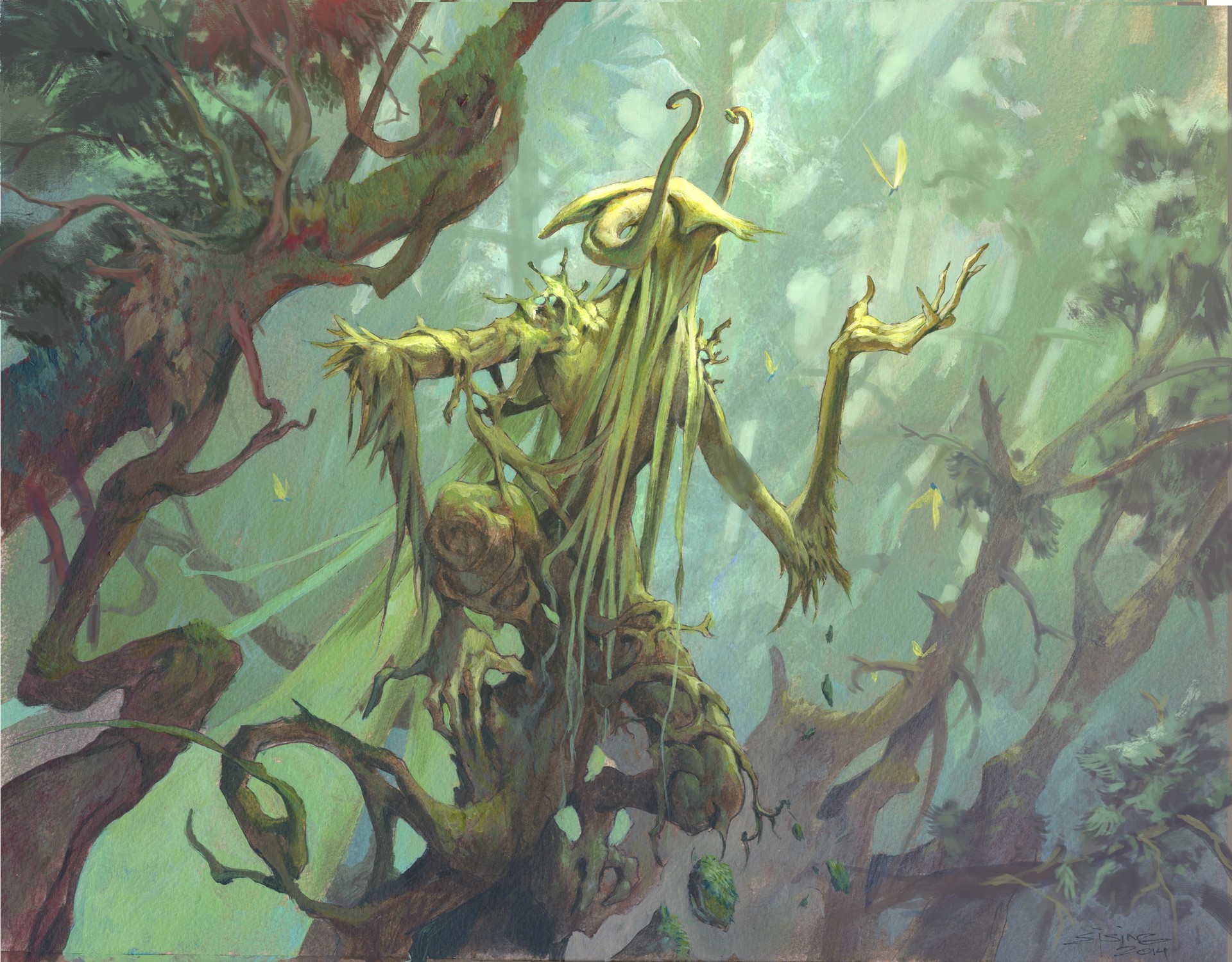 |
| Jesper Eising |
They created the first clocks, obelisks whose shadow would reveal the time and date. They pioneered many light-producing spells. They named the sun Ianap, or "mother of hearths," for it was Her light that allowed their Mother Trees (known to them as Voria) to grow.
Voria grew from Sylvaa graveyards, which resemble thickets of vines spread across vast swathes of ground. All Sylvaa have seeds for hearts, and when they die they sink to the ground and allow the seed to seep into the earth, where it can be nourished. Eventually, if enough Sylvaa died in the same place, a network of these seeds would form and birth a new Voria - which resemble dozens of thin trees twisting around each other to form one thick trunk, with hundreds of branches.
Most Sylvaa who hailed from the same communities resembled each other, so to distinguish individuals they often carved their names into their skin. It's similar to tattoos for humans, and many Sylvaa went further than just a name - they might have entire handwritten works across the length of their body. Sylvaa were known for being fantastic writers, and in modern times original Sylvaa literature is priceless. All writing was deeply personal for them - Sylvaa were telepaths (communicating with other lifeforms by intermingling roots), and so the chance to create something that truly existed in isolation from their brethren was deeply important to them.
As lovely as this all was, it didn't last.
The Fall
Ten thousand years before the start of the most popular calendar on Loom, there was an event known as the Fall of the Archlords. Orias and the five other creator deities split across lines that most mortals don't understand, descending into civil war. Loom was their theatre of battle, and the planet was ravaged. Many of the battlefields still remain visibly damaged today, with civilizations living in a celestial body's scars.At the end of this war, drastic measures were taken that would ensure no side was a true victor. Ianap, the star at the center of Loom's solar system, was destroyed.
Continents were ripped from Loom's surface in the shockwave. The seas boiled off into steam, and the atmosphere was destroyed - even today it exists only as a weak blanket, scarcely able to produce rain without magical prompting. And, though the creations of all the other Archlords had left petty Loom for extraterrestrial pursuits, the faithful Sylvaa had remained. And so they were all destroyed.
Orias, weeping, reunited with her other Archlords to forge a new sun. They then all departed Loom, bitter and resentful of one another. Orias created a whole demiplane simply to find isolation. It was a perfect mirror of the planet, but entirely devoid of other life - as though it were an empty house, and only she had the keys to it.
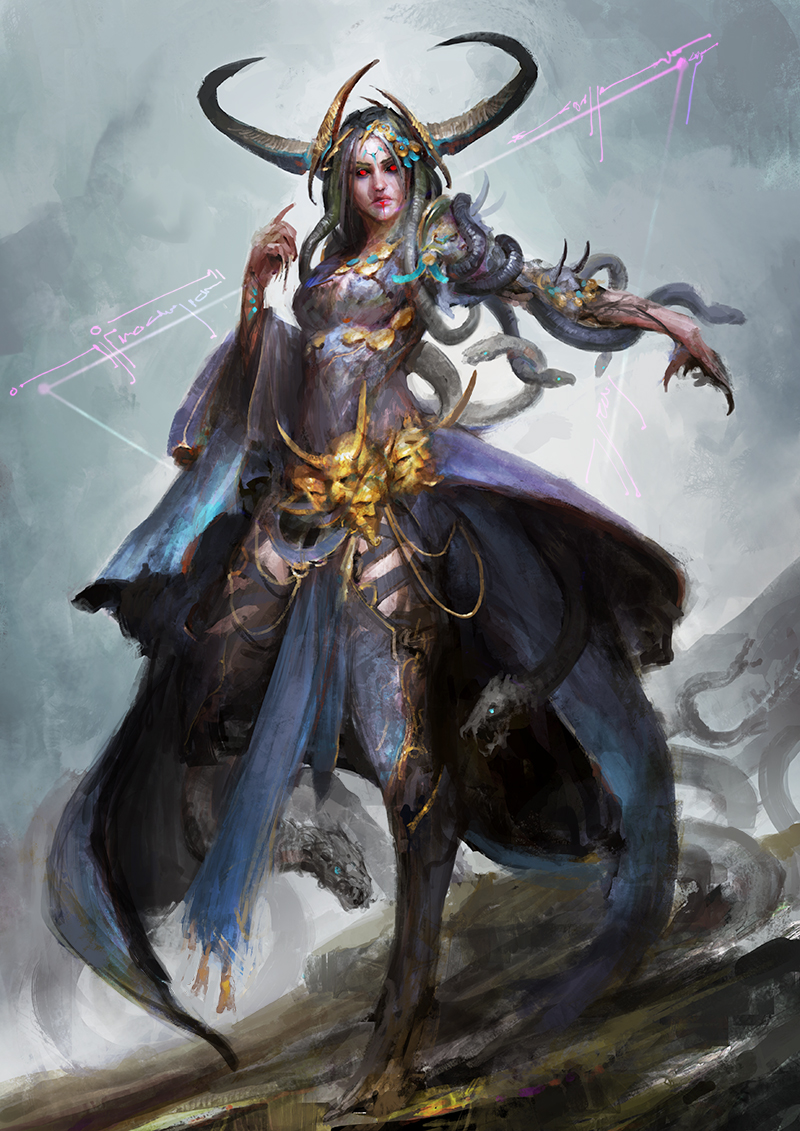 |
| Orias, as she is usually depicted after her mourning. (Daniel Kamarudin) |
She stayed in this other place for a long time, mourning. And eventually, though it took her thousands of years, she left it. She had made her peace with her lost people, and the land of this demiplane had begun to bloom again as Orias's emotional state recovered.
And that was when the Fey entered.
Redeemed
Fey are spirits, denizens of the Astral Plane born from the experiences of sapient mortals. Like many spirits, they feed on magic and emotion - which were both in abundance within Orias's private demiplane. Once she left, they infiltrated the plane and began to glut themselves, growing fattened and powerful.
However, they were eventually discovered. Orias used her demiplane as a shelter for wounded innocents during the War of Ichor, and that was when she discovered the spirits. She was furious, and ready to destroy them - kind as she was, she was no longer tolerant of anything remotely close to betrayal. However, four quick-witted individuals struck a bargain with her: they would attend to the wounded she had brought in, and the rest of the demiplane, caring for them both. They would do this for the rest of time, becoming stewards of this place that was paradise to them.
Orias, having missed calling herself the mother of a people for a long time, accepted. She named the spirits fey, "redeemed" in Sylvan. She named the plane the Feywild, and changed her long-defunct title to the Archfey.
However, it was not the fate of the Sylvaa to be remembered only as the creators of a language. Their graveyards are not just the resting places of the dead - they are cradles for new generations.
Regrowth
Eventually, the Sylvaa reappeared on Loom. In its 14th century after the War of Ichor, the planet was invaded by a hostile alien force. These were the Yugoloths, hailing from a planet or two over. This event was called the Shattering, but it isn't the point of this paragraph. What is relevant is what they brought over.Unbeknownst to Orias, a small amount of her original progeny had developed incredibly powerful teleportation magic. The Sylvaa were the original builders of Loom's massive teleporter pads, but some had grander aspirations than just that. These nine Sylvaa wanted to travel to the sun itself, so that they might worship it directly (they were also working on a way to not be burnt to a crisp in this process).
One of their test-runs, to push the limits of how far they could travel, was to Yugo. They all went together, and upon arrival they all perished. Yugo's atmosphere is toxic to most of Loom's inhabitants, and Sylvaa were no exception. Their seeds were buried in foreign soil, an environment that could never host them.
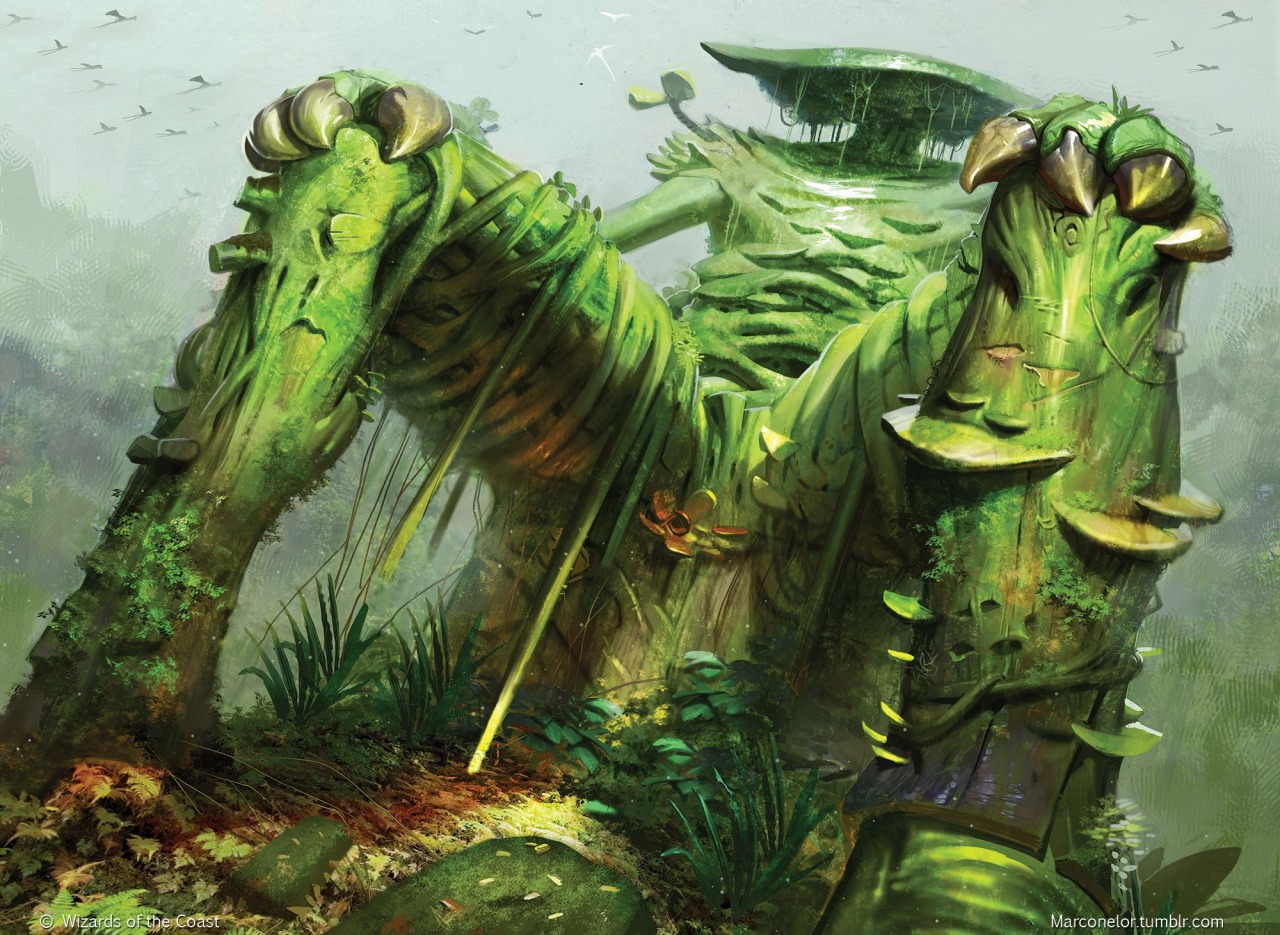 |
| Marco Nelor |
Around ten thousand years passed. The seeds of these nine burrowed into Yugo's earth, right into deposits of iron. They were eventually discovered by prehistoric Yugoloths, who cherished them as curious relics. Ose, their adoptive god and another Archlord, saw the seeds for what they were. He was exiled from Loom, and so could not return them himself - but from this point forward he nudged them closer and closer to space travel, so that they might eventually visit Loom and return the seeds.
His efforts were successful, but the visit from Yugo was hardly peaceful. A story for another time. The point, again, is that these nine seeds, able to be nourished by sunlight from Loom's new central star, Vant, jump-started Sylvaa society. They had been reborn into a curious new world, and they found they had much work to do.
Sylvaa Stats
If you want to play a Sylvaa, here are the stats I would recommend. They're tuned for 5E, but if you use another system hopefully this provides a decent-enough framework. Roleplay-wise, Sylvaa are known for their great literature, sun worship, and general confusion at much of modern society. They primarily speak Sylvan.Ability Score Increase. Your Wisdom increases by 2, and your Constitution increases by 1.
Empath Network. You may communicate telepathically with any creature or plant within 30' of you that is touching the ground, by way of your root network. You do not need to share a language with a creature to be able to communicate with it this way, but it must be able to speak at least one language. You may communicate with plants in this way regardless of their ability to speak.
Photosynthesis. You may gain the benefits of a long rest by entering a dreamlike state while immersed in sunlight for 4 hours. During this time, you are considered to be asleep, and are not aware of your surroundings. After 4 hours have passed, you gain the benefits of a long rest and become fully nourished for the next 24 hours. You may still eat and sleep normally, and will need to do so when you lack access to direct sunlight.
Natural Spellcasting. At 1st level, you may cast Dancing Lights. At 3rd level, you may cast Entangle once per long rest. At 5th level, you may cast Daylight once per long rest. You use your Wisdom score for the purposes of casting these spells.
(I should note these stats are almost wholly borrowed from the Sprouting Chaos Player's Companion by BoltNine Homebrew. People on Loom have played Sylvaa before and I wanted to keep the statblocks consistent-ish.)

