Showing posts with label game design. Show all posts

Tuesday, September 8, 2020

GLOG Rules/Class: Species-Based Abilities and the Xenomonk

D&D and Race


"Race" is a pretty pervasive concept within tabletop games, both mechanically and narratively. Unsurprisingly, people love some elves in their elfgame. But D&D (in specific, though this conversation could certainly extend to many other sword-and-sorcery systems) has been catching more and more flak as of late for the colonial undertones race presents. Alignment is a particular sticking point there, but my thoughts on alignment have already been documented.

Behold Her has a great episode on decolonizing D&D, which brings this issue up from a narrative standpoint. It's a great thing for any GM to listen to, especially if you're white and worried about creating upsetting scenarios for your players of color. Thanks goes out to my friend and fellow-GM Sam for recommending this episode to me.

However, the idea of "race" still creates problems on a mechanical level. If we're just viewing this within the context of the game, I'd call it an issue of system bloat. Races have abilities because they "have to," and also to feel different. This is especially a problem in D&D, where it's created long-lasting synergies that make certain builds very common. 

Regardless of how you feel about "builds" in tabletop games, this phenomenon is antithetical to the design goal of making races "feel different." Your half-elven bard, or halfing rogue, or especially your human fighter actually feels less unique, because that's already been done so often.

And if we look at this from outside the perspective of the game, it still has a lot of colonial undertones. I was made most acutely aware of this during an anthropology class, of all things. We were looking at a chart related to the Four Humours theory, and specifically one that postulated that each "race" (really broad-scale ethnicity - people from Europe, East Asia, Africa, and Indigenous Americans) had too many of one of the humours.

As the theory went, this led each race to have certain strengths and weaknesses. Europeans were smart and creative, but overly sensitive. Meanwhile, Africans were inherently strong but also naturally lazy and less intelligent - that sort of thing.

This left a particularly bad taste in my mouth because I realized "oh, shit, this feels like I'm flipping through the PHB."

Clearly, something had to change.

Bloodborne McGee.


Tabletop and Species


Here's what I arrived at:

First off, let's not call these "races." The idea of race is a societal construction that's existed for centuries for the explicit purpose of oppressing people and justifying violence against them. Although the idea has been somewhat reclaimed in modern times - and something being a societal construction doesn't even mean it's less real - the term is especially distasteful in the context of medieval settings rife with imperialism and slavery.

Moreover, it's not very accurate. The classical drow, dwarves, and dragonborn are much closer to distinct species than genetic variations on a single type of organism. I'm sure if you were more studied than I was in biology there could be an argument here, but frankly I enjoy my science as far away as possible from my elfgames.

So, let's call them species. I know that's what I'll be doing from here on in article. I should also, again, give props to the friend that got me doing this initially - another fellow GM, Ace.

As for how to back them up mechanically, my current favorite answer is to just not do that at all. It bogs down character creation with unnecessary choices (a particular hazard for one-shots) and can quickly slip back into uncomfortable colonial-thought territory.

Of course, in some cases it just makes sense to allow stuff - yeah, of course the gnome can fit into the vent shaft, sie's small. Or, sure, the techno-person can interface with the ancient magitech computer, but can you roll me a Will save against a dormant arcanovirus? Just approach it the way Background does in LANCER - either the player or the GM can invoke a player's species to make checks easier or harder.

If you happen to be playing or designing a crunchy system, where you want the additional complexity and synergy-opportunity, just let your players start with some feats (or whatever the equivalent is). That makes it so who they are is still mechanically important, but "who they are" isn't just their genetics.

But there's "GLOG" in the title to this post, isn't there?

Goblin Arts of Gaming


Consider the next half of this post to be a very extended Joesky Tax.

For a system designed to be pick-up-and-play and with an emphasis of getting unique abilities and items outside of the normal leveling structure, the GLOG is a unique opportunity to approach species as a concept. I've yet to playtest this, but here's what I'm thinking:

Species, by default, have no real abilities. As mentioned above, there might be some invoking of species where appropriate, but there's no bonuses to ability scores or unique actions. Sure, you're an axolotlfolk or whatever, but chiefly you're a person.
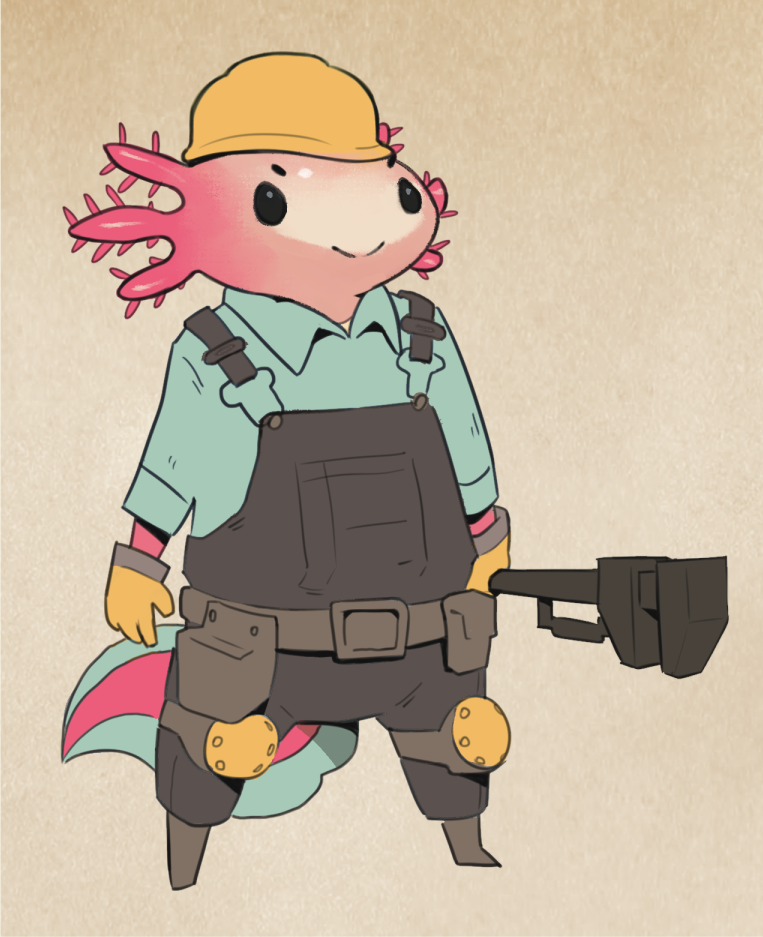
Britzmark. I originally found this image on tumblr but this artist has deleted theirs.


However, your species does still open up some unique opportunities to you. If you seek out someone who has followed this path before you, you might be able to find someone that knows a species-specific martial art.

These usually incorporate the unique biology of a species in some way or another, and will grant an ability at the expense of some sort of opportunity cost. I've written some up below, in the format of Species Ability - Training Duration - Restrictions, but adjust them to use as you see fit. And for heaven's sake, write some of your own.

Dragonborn - Voice of Rimhr
"And lo, our GodoG was once a peaceful being, who promised us sweet paradise on this earth and beyond it. But we were corrupt, and we sinned against HimiH, and we fell to bitter fratricide and enslavement. And thus, our GodoG-NameD-RimhR burned HisiH voice to ash, so that we may instead speak in a purifying flame."
Ability: As a standard action, you may breathe flame in a cone directly in front of you, dealing 1d6 damage for each level you possess (capped at 4d6) to everything in the area and lighting about half of the loose/flammable objects alight (the GM chooses based on what would be most interesting), save for half. If you use this ability again before you have had the chance to eat more of your rations and re-stabilize your inner flame (takes at least the duration of a short rest), you also take this damage. Additionally, you can always start a fire.
Training Duration: Six months, with regular practice afterwards. Dragons don't have a lot of free time.
Restrictions: Your diet must consist of primarily flammable things - mostly, lots and lots of oil. Your rations cost twice as much and are vulnerable to being destroyed when you take fire damage, like a scroll would be. Additionally, you have disadvantage on all nausea-based saves - that stuff doesn't stay down easy.

Drow - Arachnopotheosis
"We are the firstborn of Iuedaiya, and so it falls to us to uphold this community - no matter how many hands it takes."
Ability: At the beginning of your turn, you may sprout four extra arms. This grants you +4 attack and +4 inventory slots for the remainder of the combat (or, if used in less strenuous circumstances, an hour). This ability refreshes every new moon.
Training Duration: Eight weeks and access to two sets of mechanical "practice arms," which are ubiquitous in Underdark cities and basically nowhere else.
Restrictions: You have -1 attack and -1 inventory slot during the day, which you must fast through (so no consuming rations during daytime rests, either). Insects also hate you unconditionally.

If you are a human, you have a 10% chance of possessing the appropriate biology to be able to learn a species-specific fighting art. This is less a genetics thing and more to do with fleshcrafting - humans are not a naturally-occurring species, and instead have been "discovered" in multiple eras by multiple different fleshcrafters as the exact middle point between all sentient species. They're a useful base to work off of. This is also why the term "humanoid" exists.

Aside from that, the only way to learn the fighting arts of species you don't belong to is to become a Rykian Barber.

GLOG Class: The Rykian Barber (Xenomonk)


Rykian Barbers, adherents to the old god Rykus, are a usually-maligned group of monks, and so their monasteries are located primarily within the hinterlands of any given society. One of the few places where this is not the case is within Hazzem's Rikolese Empire, where practical and aesthetic fleshcrafting are deeply ingrained within the culture. Rykian Barbers are mostly nice and do the typical monk things of archiving religious texts and healing travelers for free, but if you die within their walls, your family will not get your body back.

Xenomonk A: Barber, Autocanopic
Xenomonk B: Student's Tongue, Student's Uniform
Xenomonk C: Blisternode, Rykian Conflagration
Xenomonk D: Allocanopic

Starting Skill [1d3]: 1 = Archivist, 2 = Personal Stylist, 3 = Necromancer

You begin play with an adjustable-size scalpel (1d6), burgundy robes, three doses of desiccating powder (dries and preserves organs until exposed to water), and a begging bowl.

Barber: You gain the Barber skill at rank 2. This skill can be useful to heal longer-term injuries, or even suppress spiritual or mental illness with access to the right ingredients.

Autocanopic: You may make a Barber skill check to harvest exotic organs from felled creatures. On its own, this does nothing except provide as a potential source of income (and if you've been doing this for awhile, you probably know somebody who wants monster or people bits).

However, you can also make a Will check during your downtime to sew these bits into yourself (you may gain +4 to the check if you get someone else with the Barber skill to help you). You may have a maximum number of organs transplanted this way equal to your level in this class (maximum 4). This allows you to learn fighting arts typically restricted to other species, provided you can find someone willing to teach you.

Even non-sentient species, or those considered "less civilized" (think ogres or demons) will usually have a species-specific fighting art, though finding someone to train you in it may be significantly harder (you might even have to seek out a high-level Rykian Barber to do so).
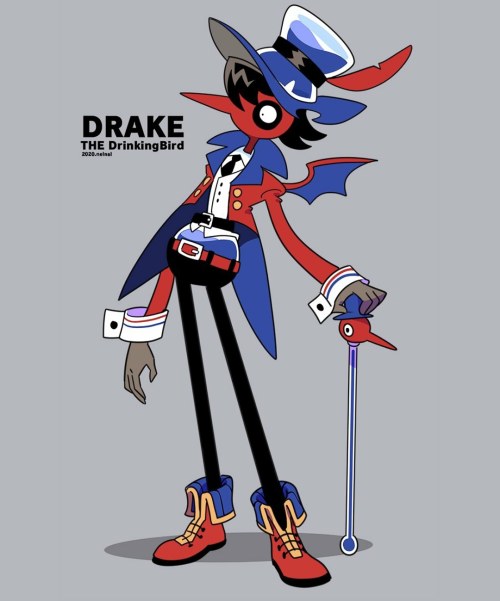
Nelnal. Obviously, Xenomonks have the capacity for incredible fashion power.


Student's Tongue: You may now use your Autocanopic ability on the tongues of other species, requiring the same Barber check to harvest and Will check to transplant. This allows you to speak the language at rank 5 - pretty much fluently, but lacking cultural context. This newfound language proficiency will only last you 24 hours, so use it wisely.

Student's Uniform: You may also use Autocanopic to masquerade as another species, which consumes the whole carcass (minus any other harvested organs). This requires a Barber check, but not a Will check (you're not transplanting anything). Again, your disguise will last 24 hours.

Sidebar: The two above abilities are primarily useful for finding a master for a species-specific fighting art, as these abilities are usually spiritual and wouldn't be shared with outsiders, if it were even (normally) possible.

Blisternode: Your extraneous organs have no more space to fit in your body, so you have installed a large "blister" in yourself to fit more. It swims under your flesh in an unsettling manner. Whenever you take damage from an attack, you may intercept it with the blister, sacrificing one of your currently-transplanted organs to reduce the damage taken by 1d6.

Feel free to change the flavor on this ability, because it's kind of fucking gross. But this whole class also is.

Rykian Conflagration: When you activate a species-specific technique, you may choose to "burn through" the organ, pushing it to the limits of its biological capabilities. This destroys the organ, deals 1d6 damage to you, and empowers the ability in some way. Work with your GM to figure out what this means - the possibilities are too wide to codify this.

If you have more samples of the organ, it is of course possible to reinstall them, and you don't have to go through the training process again if you do.

Allocanpic: Autocanopic, Student's Tongue, and Student's Uniform can now be used on other people. A non-Xenomonk person can only hold one extraneous organ (usually in place of their appendix, which is usually how they pay you for services rendered). These installations usually take around four hours each - longer than the usual self-transplant, since their bodies aren't as used to the physical trauma and need a longer recovery period.

Wimps.
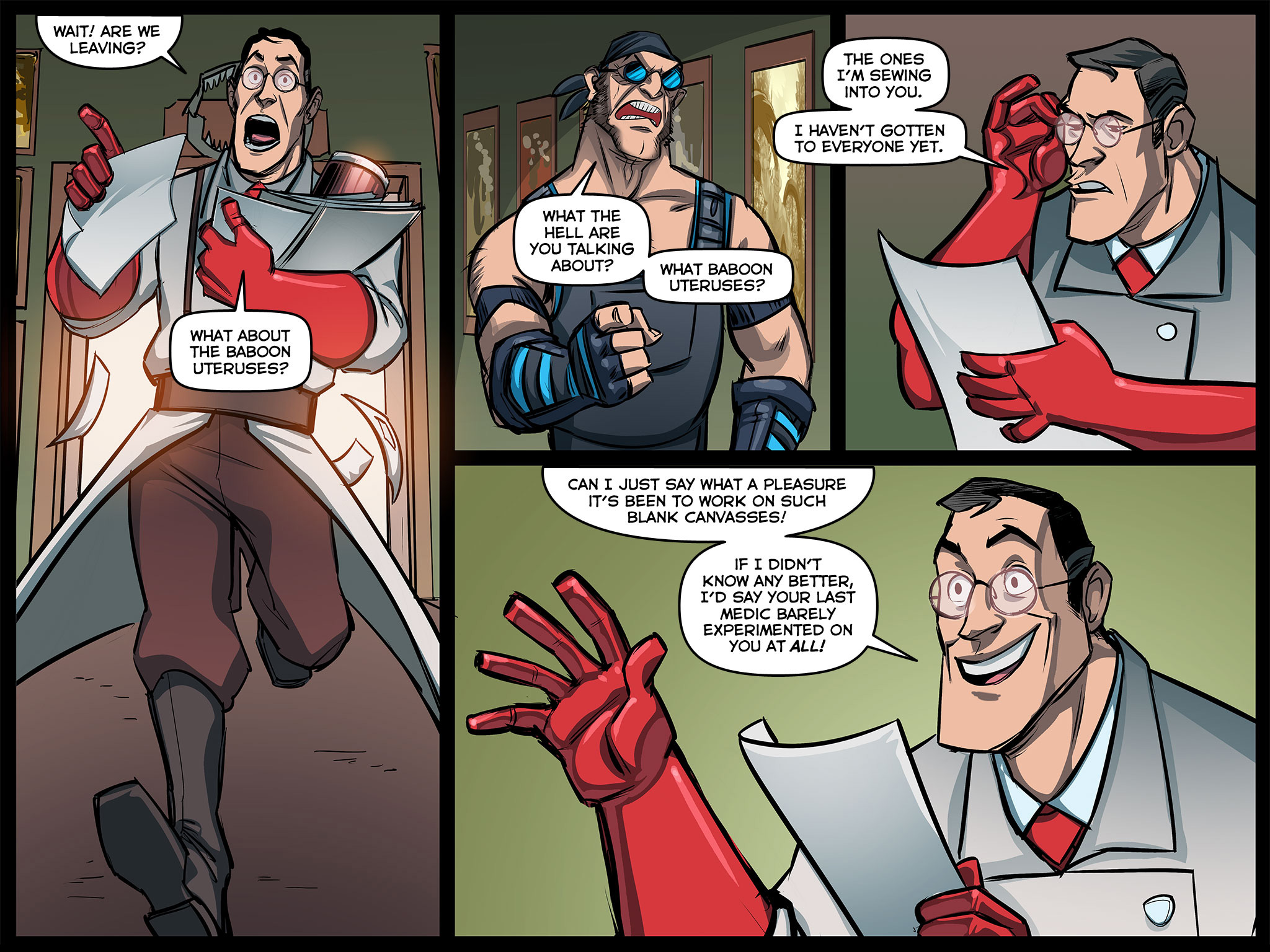
TF2 Comics. Medic is obviously a Xenomonk.


Closing Thoughts


Design-wise, this class is like a more gore-y version of the Reliquarian. Lately I've just really been enjoying designing classes that incentivize looking for a specific thing. It's what makes some of the classic classes great - Wizards keep an eye out for scrolls, Fighters keep a lookout for really good swords, and Thieves look for easy marks. It helps push player ambition and GM design space.

Big thanks to Magnus, who suggested Blisternode and Rykian Conflagration, which was what I needed to finally get off my ass and finish writing this. It's kind of brilliant - right as you start to have a lot more options in what organs you can haul around in you, you also get incentivized to give up your current ones in exchange for new ones.

And also thanks to everyone who helped me in the process of writing this, whose twitters I've included links to above. They don't really post much TTRPG content, but they have good ideas and that is worth crediting.

Finally, these rules and the Xenomonk were written in reference to my own rules for skills and stuff. They should be pretty compatible with most GLOG permutations, but I'll probably post my personal GLOGhack rules here sometime.

Friday, April 24, 2020

Treasure Monsters


The Mimic is a great monster because the party's approach to dealing with it changes as they get better at the game.

The first time a Mimic bites your thief's arm off, players will know to be on the lookout for them going forward. Actually, it usually doesn't even take that long - most people with any sort of background in gaming know what a Mimic is, and whenever I have a treasure chest in a dungeon at least one of my players worries about a Mimic.

This is how the Mimic goes from Monster to Trap. It transforms from an encounter into a problem that can be solved with creative thinking. Give the Mimic some of your rations, or hit it with a sleep spell/potion, and you can take the contents of the chest and be on your merry way.

However, some players take it even further. Once your players realize that the Mimic can be subdued in this way, they realize that they can use it against other enemies in the dungeon. After feeding it, pick it up and move it into the room where you saw those goblins. Make a loud noise, hide, and watch the goblins get themselves eaten.

This is how the Mimic goes from Trap to Treasure. Other examples of this are spring-loaded poison needles that poke anyone getting tricky with a lock, or spears that jut from the walls when you step on a pressure plate, or any trap that you can trick monsters into walking into.

Monster, then Trap, then Treasure. The progression of a great monster. Let's try to write some. Explanation of system-agnostic statblocks here.

Scribblies


Scribblies come from wizard apprentices who die while carrying their masters' loose scrolls. They only form if not given a proper burial.

SIXMOREVODKA

Scribbly
HD 2 Size Small AC As zombie Speed As dwarf
Languages Common (Can speak, only understands written.)
Quill: Dodge 12, 1d6 

Scribe - Anytime a spell is cast within the Scribbly's line of sight, it automatically records that spell onto itself, as a scroll. Any given Scribbly in a dungeon will already have one spell recorded onto it. It can store as many spells as it has HD. When it dies, any spell still scribed onto it is recoverable as a scroll. You can also show a Scribbly a page of your spellbook or a loose scroll and it will scribe that spell onto itself. This makes it friendly.

What spell does this Scribbly already have scribed? (1d4)
1. Sleep
2. Fireball
3. Polymorph (into Gelatinous Cube)
4. Summon (Elephant)

Recitation - As an action, the Scribbly can recite a spell currently stored on it. This causes it to cast that spell on a random target within the spell's range, consuming that scroll. It automatically takes this action whenever it takes slashing, piercing, fire, or acid damage (or damage of any other type that would harm the scroll - it's screaming out "oh no, not the precious scroll of fireball!" which counts as the verbal component for that spell).

Discussion: I haven't playtested this, but I like the idea of it a lot. I would only put it in an area with other monsters, or at least put it near them. If you put it on a random encounter table, it could be something like "2d6 orcs and their warlock leader wander into a room with one Scribbly," or whatever.

I'm hoping the progression here is "fight it once without realizing what its deal is" > "figure out its deal and try to exploit it for a free scroll" > "load it up with a dangerous spell by showing it the wizard's spellbook and then get it to wander into a room full of stupid enemies."

I would also experiment with older Scribblies that have higher HD. Make them more resentful of their fate, and meaner. And also let them trim off pieces of themselves to summon lesser Scribblies mid-combat. Would probably make for a good boss monster.

Belcher


Belchers look kind of like blobfish and occupy a similar ecological niche as the mola mola: it just isn't worth the trouble of hunting down for anything to really bother eating it. They're actually really shitty air elementals, holdovers from an ancient underground civilization that saw air and fire as opposites. (On Loom, elementals are spirits that form from cultural conceptions of "the elements" - so yeah you have the water/fire/air/earth ones, but also Xenon Elementals, Feminine Energy Elementals, and Piss Elementals [goblins consider piss to be a core element].)

Hollow Knight

Belcher
HD 8 Size Medium AC As leather Speed As dwarf
Immunities Fire, Indigestion
Bite: Dodge 14, 1d6 + attached (detach check is DC 20 or whatever an unreasonably hard check is in your system.)

Dry Ice - The Belcher constantly vomits up vision-obscuring fog in a 30' radius around itself. If the Belcher is killed or leaves an area, its fog remains for a minute. Wind effects, unless continual, will only disperse the fog for a round.

Photophobic - Belchers will relentlessly attack light sources. They'll crawl up to explorers and eat their lantern(s). They only attack people if those people attack them.

Discussion: Belchers have a lot of health, and are a pain in the ass to kill. If you're trying to get past it, the best option is honestly to just douse your torch and move on. Or light up an arrow and shoot it down the hallway you just came from. Better yet if those manticores were still chasing you.

Again, I would only run these with actually threatening other monsters nearby. Or you could have it screech loudly when damaged, causing other nearby stuff to come investigate. 

There's also the option of tying it to a rope and dragging it around as a free fog cloud.

---

Update on Ability Scores, But Shitty:

I ran about half of The Meal of Oshregaal on Sunday with Deficiencies replacing Ability Scores and it went pretty alright. It definitely takes getting used to, and we didn't actually get into any combat, but I think it has promise. I didn't have any moments where we had to stop and go "wait, is this 18 good or bad" which I've seen happen a little bit with the GLOG. The whole thing might wind up being unnecessary, but we'll see. I think combat will be the real test.

Wednesday, April 15, 2020

Ability Scores, But Shitty


The Oblidisideryptch has a great GLOG-hacked system of "roll over your low ability scores" to overcome challenges, as opposed to the GLOG's usual deal of "high ability scores that you have to roll under."

This fixes what might be considered a fundamental problem with the GLOG - human brains just tend toward High Number Good. Well, it kind of fixes it. It makes rolling ability checks - the bread and butter of tabletop dice games - make higher numbers better, which appeases the brain.

However, it isn't perfect. Anyone with a background in D&D has probably done a little bit of minmaxing in their time, and we cannot escape the trappings of High Number Good. I test-rolled some scores in The Oblidisideryptch's system, and it felt jarring to see a 14, be initially excited, and then realize that it was a bad thing. Besides, it just feels weird to see "Strength 12" as an indicator that I'm somewhat on the weaker side.

So, in a completely inelegant solution, I am proposing that we just make the ability scores shitty. Perhaps the brain rule isn't High Number Good so much as High Number More, and so we just have to make the number have a negative connotation.

James Fenner


SO, presenting the NEW AND IMPROVED ABILITY SCORES (AKA YOUR DEFICIENCIES):

FATIGUE, a measure of the body's tendency to give out when pushed to its limits.
IMPAIRMENT, how likely you are to trip over your own two feet.
FRAILTY, how easily you break.
IDIOCY, your struggles with the realms of the intellectual.
IGNORANCE, your aversion to common sense.
and REPULSION, your ability to frighten away both companions and glory.

Roll 3d6 or whatever for each. Ability checks are made by rolling over your Deficiencies.

Looking at this, I like it a lot, but I have no idea how it will play. I tend to enjoy stories that are about the players overcoming personal things - usually, in the past, that's had to manifest purely through roleplay involving that character's backstory. With this, it can be woven into the very fabric of the game.

Watch your Idiocy decrease as you gain a level and have a revelation after all that time spent combing through the books of the Great Braille Library. Groan as your Fatigue soars to new heights (temporarily) after eating a plant you didn't know was poisonous.

Overcome your deficiencies. Or at the very least, survive with them.

this is also you. this celestial envoy plays with a slightly different set of Deficiencies, but it's also of a different species than us so i feel like that's fair.


Thursday, November 14, 2019

Skills

Here's my attempt to write rules for skills in my spontaneously-self-resurrecting homebrew tabletop system. These aren't complete by a long shot - there's work to be done in regards to how you go about getting them, but this post is just focused on how you play with them.

My goals for these rules are:

  • To use a passive/active system for skill checks that incorporates both Intelligence and Wisdom
  • Avoid modifiers, and use a roll-under system
  • Let the players utilize items to mitigate proficiency deficiency
Madison Safer
Skill checks represent the player characters using their talents and experience to modify their situations. There are two types of skill checks: Knowledge checks and Application checks. These are both d20 rolls.


A successful Knowledge check allows a player character to recall information that is pertinent to the situation. To make a Knowledge check, you check your roll against your Intelligence. If it is equal to or lower than your Intelligence score, you are successful.

You cannot make Knowledge checks untrained, unless you have a source of information on-hand.

Application checks, when successful, allow a player character to significantly change their circumstances. They're more powerful than we consider skill checks in systems like 5E. Application rolls are checked against Wisdom instead of Intelligence. Whenever you succeed on an Application check, cross it off for the day - you cannot use it again until you rest.

You can make Application checks at a penalty if you are untrained in them. This caveat can be ignored if you have the proper tools for the job. 

If you roll under your Wisdom by 5 or more, you do not have to cross your skill off for the day.
If you roll under your Wisdom by 10 or more, you may tack an adverb onto your action (thanks Arnold).

Some classes have access to exclusive skills. Rangers get Terrain as a skill, which they use for tracking things and altering battlefields. Wizards get Spellbook and Relic as skills, which they use for casting. Other classes will have access to these skills (untrained, obviously) on a case-by-case basis.

Sunday, September 1, 2019

Rumor Tables

I'm prepping for an upcoming campaign, and the first session involves collecting rumors. So, I figure I'd better write rules for rumor tables - something I've done before, but wanted to take another crack at.

My last ruleset had players roll 1d6 while I flipped a coin, asking the player to call it but not telling them what it wound up as. What they rolled determined which general rumor they would hear about, while what I flipped determined whether or not the details were true or false. For example:

GENERAL: Rumor has it that the government of a city far to the north known as Nothokari, capital of the Coatbysk, has discovered an ancient magical artifact that was thought lost.
TRUE: The artifact, known as the Witchcrown, was confiscated by the city's current king- though some attempts to steal it have been made already.
FALSE: The current king, known to be a Lightclaimer sympathizer, is currently negotiating a selling price with Subjugator Garrel.

While that system is perfectly functional, I wanted to tweak it. My goals were:
  • remove the secret coin flip - it's better if players aren't necessarily aware that they can find false information.
  • ease the amount of work I, as a DM, have to do. rumor tables shouldn't take more than a few minutes to throw together.
  • incorporate Charisma into the roll, so that some characters are better at collecting rumors than others.

So, that in mind, here's my new system:


Whenever a player wishes to collect rumors, they must pick a specific region or topic to gather rumors on. Then, they roll a d6.

Each rumor table will have at least one true rumor on it. Additionally, the DM will add a number of additional true rumors to it equal to the player character's Charisma modifier. So, at +5 Charisma, the table will be entirely true rumors.

Every other rumor on the table will be, in some way, untrue. It might be a partial lie, or entirely made up. Ideally, even fake rumors point the party in the direction of something interesting. Sure, there might not be buried treasure at the destination they were given - but there is a tiny village home to sprites.

So, as an example, here's a rumor table for Selka. My process for writing these was to do the true rumors first, and then copy and paste the finished rumors to the false section, changing them slightly. Then, I would write an expansion upon the rumor in the spot it left on the true table. This leads to the "false" rumors mostly just being outdated or undetailed, which I like.

However, each table does have at least one true rumor independent from any on the other table. For the True table, this is the omnipresent true rumor that each character has a chance of finding regardless of Charisma. For the False table, it's just something completely made up and not even partially true.

TRUE RUMORS:
  1. Recently, a fungal infection has inflicted heavy damage on this year's war-snail population, damaging trade with other nations. An emissary from Ghr'quoz, a Selkian underwater city, is visiting the surface to investigate, and will pay handsomely for anyone who can help. (stagnant true rumor)
  2. Mining operations for a substance that will burn even underwater in northeastern Selka have halted due to a cave-in, which some say was caused intentionally.
  3. An ancient, immortal warrior from the Obsidian Tide is supposedly being hidden in a large barn somewhere in central Selka, with a visiting Dobarkoli anthropologist attempting to translate the giant's mutterings.
  4. An arctic druid roused the slumbering water spirit within a Selkian glacier, attempting to use it as a weapon of war - which the water spirit wants nothing to do with. It's attempting to run, but that mainly means slowly sliding through eastern Selka.
  5. A mad wizard living in the Brimstone Marsh has been searching for an apprentice as of late, but has been attacked at all the rural villages he's visited - causing him to destroy many of them, mainly in self defense that's gone a little too far.
  6. A number of Selkian exiles have discovered a potent hallucinogen that allows for the development of psionic powers, which they've circulated along with more mundane narcotics - blaming the whole thing on the Rikolese Empire.

FALSE RUMORS:
  1. A visiting Raahilan gunsmith has developed guns for the Selkian military that will function underwater. The factory for them is located along the country's northeastern coast.
  2. A seal rancher recently uncovered what appears to be the crypt of a Giantine warrior while looking for grazing sites.
  3. A glacier that has stayed stagnant for centuries, and is also part of an important religious ritual for pilgrims from Sharsvud, has recently begun to move southward for no apparent reason.
  4. A horrific beast from the Brimstone March has begun to devastate the rural communities of western Selka.
  5. The neighboring Rikolese empire has been smuggling experimental alchemical drugs over the border to attempt to create a dependency among the Selkian surface-borne population.
  6. In southern Selka, there are rumors of a revolution among the Nautilid population, who have long wanted to establish their own nation.
Malachai (Cha +3) and Wrex (Cha -1) both roll to gather rumors about Selka.

Malachai rolls a 5, just over their threshold for a true rumor, and learns about the drug trading going on along the Rikolese border - but doesn't hear about the true party behind it.

Wrex rolls a 1, luckily hearing about the truthful rumor about the fungal infection among Selkian war-snails. 

---

Okay, well after writing this I would actually say it takes longer than my previous system. But it is a lot of fun, and I think a little more streamlined for actual play. It's also a good way to get the gears turning on questlines. I think I'll try this system out in my next campaign, and maybe report back on if it works or not.

Tuesday, January 1, 2019

New Year's Random Encounters

Still working on the second part of the Age of Eight Plagues. But I was struck with inspiration for some random encounters while watching The Twilight Zone, and I want to take it as far as I can.

Goals for this: create a world that feels interconnected, experiment with random encounters that revolve more around roleplay/exploration than just combat


  1. While walking along a trail, you come over a ridge and notice a wispy smoke coming from a bit further along the trail. Keep walking and you start to smell burnt flesh and hair. Eventually, the party comes along a broken bridge, 1d8 mangled corpses, and 1d4 mangled (but alive) soldiers. If asked, they will explain that they were going to hang a local criminal when they heard her watch ticking. Upon the captain pulling it out and putting it in his pocket, the damn thing exploded and took out half the bridge and most of the company. The criminal is nowhere to be found. 50% chance one of the remaining soldiers knows her name. At the very least, the party needs to find another way across the river. But there's also sidequest potential here.
  2. Immediately after coming into a clearing, an arrow/bolt/bullet whizzes past the party leader's head. The party then takes notice of the 2d6 bandits taking cover behind rocks and fallen trees in the clearing, and has ten seconds to declare they hop into cover before they get shot at another 3d4 times (one for each bandit on the other side of the clearing). They've walked right into a shootout between two gangs. The enemy bandit leader has a gun, if you're running a time period when they're rare-but-existent. Give them one bandit taking cover behind the same rock as them to talk to, but otherwise just see what they do.
  3. An abandoned farmstead. There are unharvested pumpkins in the field, watched over by three stoic scarecrows. The house stands with its door open, creaking in the wind. On the porch is the corpse of a boy, no older than ten. Inside there's a kitchen, a big bedroom, and two smaller bedrooms. The big bedroom has the corpses of the parents, and in one of the bedrooms is the corpse of another farmer and a scarred, passed out girl of no more than sixteen. Her name is Magpie, and she fought off the rival farmer - but not before he slaughtered her family. If you help her, give the parents proper burials, or take the rival farmer's body off of the property and burn it, you can sleep in the house and even take some of the food. If you hurt Magpie or take any of the food without helping her, the scarecrows will come alive and attack you (possessed by the spirits of her family, of course).
  4. A druid and 2d3 coyotes that have ransacked a camp of 1d6 sleeping soldiers. The coyotes are eating their entrails while the druid melts all of their possessions, wood cracking in the flame and coinage melting into slag. The druid knows the party is there, and will let them walk away.  But if they come too close, he will order the wolves to attack. He wants nothing to do with you, steeped as you are in filthy civilization. If you do fight him, the fire will burn all of the treasure here into worthlessness within three combat rounds. (I'd probably say it's worth 3d10x10 GP in 5e, scale up/down as needed).
  5. While crossing a bridge, you see a girl missing an arm floating down the river, left side of her face burned and stump dyeing the water around her crimson. She's unconscious, but alive. This in the criminal from entry one, named Kudzu. She's an anarchist, potential companion, and party-level rogue with an affinity for explosives. She'll propose that she go with the party if nobody else does, without mentioning that the law is after her. 25% chance of her having connections with local anarchists in any town you visit from now on. Within the largest nearby city, authorities will pay 250 GP for her alive, and 100 GP for her dead (adjust as necessary).
  6. Poorly built wooden tower belonging to a local gang that's busy with a shootout right now. There's only 1d6 bandits guarding it right now (50% chance each is asleep) but the real danger is the traps present. A tripwire in the front door activates three crossbows, a bucket with a hornet's nest in it set on top of a door left ajar, ceramic pots with slimes in them (painted with red stripes). Not a lot of gold or practical items to be looted, but the bandit leader's room has a lot of expensive antiques in it (200 GP total to be looted if they all make it to the city).
Druids and their wolves. Image source: Riot Games

Tuesday, December 4, 2018

Fey Statblocks

Gonna take my first crack at writing system-agnostic monster statblocks. Here's some general rules:


  • HD is hit dice, obviously. If you're playing 5E or something more modern/with generally larger statblocks, double whatever amount I give you. If monster level or CR are important for some reason, just refer to its HD.
  • Size is most important for determining what dice the monster uses for health. Medium sized = d8, going up or down a die step with monster size. General sizes will be Tiny (pixie), Small (goblin), Medium (human), Large (ogre), and Huge (giant).
  • AC and Speed stats will be given in reference to something else in the system for ease of translation.
  • Attacks will be given with damage dice, any bonuses, and if deemed necessary damage type. They're given with a DC to beat, but if you roll attacks for monsters just take ten off the DC and add it to the attack.
  • Multiattacks are written as: "Attack 1 + Attack 2."
  • Creatures with a choice between two attacks are written as: "Attack 1 / Attack 2."
  • Attacks with two different damage types are written as: " Type 1, Type 2."
  • Any ability scores that seem noteworthy (read: not common sense/easily interpreted) will be given. Otherwise, just use your best judgement.
  • Special languages, senses, and/or damage/condition immunities or vulnerabilities will be given if they exist.

With the housekeeping done, let's get to the monsters.


Krovatilde


When a fey gets venerable and senile enough, they are magically transformed into a Krovatilde and usually dumped onto the Material Plane (which the fey see as a vacation spot) as a reward for their service. This makes them, above everything else, very sleepy. They usually know a lot about whatever location they're in, as the fey who decide where they take their rests usually pick someplace they had an interest in.

They look like a big snail, pretty much. The snail shifts across all colors, lava-lamp style. The shell is usually black, with star or sheep designs on them that also glow in rainbow colors.

They're quite pleasant when they're not sleeping. Only problem is that they sleep 24 hours a day. The magical programming in their shells kicks in to defend them whenever somebody gets near. The party probably won't realize this and will just think that it's a mollusk monster. But if the party puts two and two together, upon waking up Krovatilde usually feel really bad for attacking you and will offer whatever assistance they can provide (they're usually pretty good spellcasters or can put in a favor with local fey).

Krovatilde
HD 8 Size Large AC As Platemail Speed As snail
Arcanopods: Dodge 16, 1d8 + 1d8

Comatose - While sleeping, the Krovatilde is unaffected by visual illusions. Damage won't wake the Krovatilde up (it's done to the shell), but the following things might: exceptionally loud noises (roll on random encounter table), the sensation of falling, or putting bright light down the shell's aperture.

Magic Murmurs - The Krovatilde sleeptalks. Whenever a spell is cast near it, flip a coin. On heads, it casts that same spell on a random target on its next turn as a free action.

These guys were inspired by Jirachi's fights in the PMD games.

Dullahan


I wrote about them here.

General Dullahan tactics are to restrain and behead whoever looks like the party's leader. They'll run if alone (usually after casting Mass Restrain), but they might let you kill them if it looks like you'll follow them back to their Court.

Dullahan
HD 2 Size Medium AC As Goblin Speed As human
Guillotine Blade: Dodge 11, 1d12

Courtly - While in their Court, the Dullahan have doubled HD and no limit on their spells. If killed outside their court, they reform in it in eight hours.

Headless - Critical hits deal no extra damage against Dullahan.

Spellcasting - Spell save DC = HD + 10.
At-will: Wheel of Fortune
3/day: Restrain
1/day: Mass Restrain

Grig


Members of one of the Low Courts. Like centaurs, but the bottom half is a grasshopper instead. Want to help you compose new songs about your epic deeds. This will usually involve you fighting something while they make it harder with their spells.

Grig
HD 1 Size Tiny AC As Hawk Speed As Dwarf, but moves via jumping

Courtly - While in their Court, the Grig have doubled HD and no limit on their spells. If killed outside their court, they reform in it in eight hours.

Spellcasting - Spell save DC = HD + 14.
At-will: Cure Wounds, Invisibility, Irresistible Dance
2/day: Mass Irresistible Dance

Fey Spells


Available to your party members if you really feel like it. I'd make them quest for 'em, personally. Mass spells replace "target creature" with "all creatures within a 30-foot area."

Irresistible Dance
Standard Action, Range 60 ft.
Target creature must make a Save or become unable to take any action but dance. Target gains no benefit from Dexterity to dodging and moves at half speed. On their turns, they may either attempt to make a new Save or take evasive maneuvers, restoring their Dexterity modifier to their dodging. If someone kills the partying mood (tells a really bad joke, does something particularly grim) the effect is ended.

Restrain
Standard Action, Range 30 ft.
Target creature must make a Save or become prone and restrained. Slashing weapons automatically crit targets in this condition.

Wheel of Fortune
Initiative Action (free action taken after the last creature in initiative order acts)
All creatures within the current combat reroll initiative.

Sunday, December 2, 2018

Moral Leanings and Self

This is my first post about game design.

So, story consequences are my favorite kind of consequences. Piss off the right people without confronting them and your hometown gets slaughtered. Retire your character to settle down with your new spouse or else they'll get killed trying to join you on your adventures. These kind of things don't have an effect on your character sheet, most of the time. They're aimed more at the player.

But that doesn't mean the story the game's wrapped in can't have gameplay consequences.

Death is the biggest gameplay consequence most of the time. You don't get to keep playing your character - roll up a new one, and lose all of your sweet gear as a result. Start from scratch.

But, as some other D&D blogs I read have pointed out, death isn't the only way to accomplish that. What if your character just gets sick of being an adventurer?

Here's a rough draft of some mechanics based around that.

Moral Leanings


When you roll up a new character, give them up to four Moral Leanings. These are rules that they, as characters, follow strictly. Breaking them would go against what they stand for as people.

Try to keep proper nouns out of them - usually, kicking in the teeth of the lich that killed your father is its own reward. It doesn't need gameplay to motivate it.

EXAMPLES:
"Provide medical aid to injured innocents."
"Do not strike down an enemy who surrenders."
"Bury the religious with their belongings."

Self


Self is a stat. It's how much your character is comfortable having their actions controlled by you, the player.

They aren't necessarily aware that they're being puppeteered, of course. But if they act against their own moral compass, they will begin to question themselves. Have I lost myself as a person while pursuing gold and glory? Is the adventuring life really for me? What would my mother, may she rest easy, think of me now?

When you roll up a new character, you have an amount of Self equal to 1d6 + however many Moral Leanings you have. Your maximum Self is 10.

At 10 self, you may give yourself advantage on one d20 roll per day. (This is like a less shitty version of 5e's inspiration, or at least I like to think so. It doesn't really need to be there, if you don't want.)

At 2 self or lower, you stop wanting to take so many risks. You must roll a Save vs Fear whenever you fall under half health (once per combat). If you fail, your character is only able to run away.

At 1 self, you fall into a deep apathy. You automatically lose initiative, and cannot gain initiative-based benefits in any way.

At 0 self, you lose control of your character. They probably just retire, but it's also possible they become an antagonist.

You lose one self whenever you act in a way that is contradictory to one of your Moral Leanings. You gain one self whenever you act in accordance with one of them. 

Discussion


So, this mechanic was almost entirely inspired by Deltarune's ending (that link is spoilers and contains a mild jumpscare, btw). The idea of fictional characters getting fed up with the player is really interesting to me, and I think it's a cool way to "enforce" roleplay, if that kind of thing is your cup of tea. Especially since the smartest thing to do is to start with at least two Moral Leanings, since that way you can't start off with either of the debuffs. 

This obviously isn't going to be a good thing to implement into every game. I'd stay away from this in one-shots. And sometimes players just want their characters to be mechanics-on-legs. But in longer-term games with a focus on roleplay? I feel like this works nicely (though it could probably benefit from some tuning).