D&D and Race
"Race" is a pretty pervasive concept within tabletop games, both mechanically and narratively. Unsurprisingly, people love some elves in their elfgame. But D&D (in specific, though this conversation could certainly extend to many other sword-and-sorcery systems) has been catching more and more flak as of late for the colonial undertones race presents. Alignment is a particular sticking point there, but my thoughts on alignment have already been documented.
Behold Her has a great episode on decolonizing D&D, which brings this issue up from a narrative standpoint. It's a great thing for any GM to listen to, especially if you're white and worried about creating upsetting scenarios for your players of color. Thanks goes out to my friend and fellow-GM Sam for recommending this episode to me.
However, the idea of "race" still creates problems on a mechanical level. If we're just viewing this within the context of the game, I'd call it an issue of system bloat. Races have abilities because they "have to," and also to feel different. This is especially a problem in D&D, where it's created long-lasting synergies that make certain builds very common.
Regardless of how you feel about "builds" in tabletop games, this phenomenon is antithetical to the design goal of making races "feel different." Your half-elven bard, or halfing rogue, or especially your human fighter actually feels less unique, because that's already been done so often.
And if we look at this from outside the perspective of the game, it still has a lot of colonial undertones. I was made most acutely aware of this during an anthropology class, of all things. We were looking at a chart related to the Four Humours theory, and specifically one that postulated that each "race" (really broad-scale ethnicity - people from Europe, East Asia, Africa, and Indigenous Americans) had too many of one of the humours.
As the theory went, this led each race to have certain strengths and weaknesses. Europeans were smart and creative, but overly sensitive. Meanwhile, Africans were inherently strong but also naturally lazy and less intelligent - that sort of thing.
This left a particularly bad taste in my mouth because I realized "oh, shit, this feels like I'm flipping through the PHB."
Clearly, something had to change.
 |
| Bloodborne McGee. |
Tabletop and Species
Here's what I arrived at:
First off, let's not call these "races." The idea of race is a societal construction that's existed for centuries for the explicit purpose of oppressing people and justifying violence against them. Although the idea has been somewhat reclaimed in modern times - and something being a societal construction doesn't even mean it's less real - the term is especially distasteful in the context of medieval settings rife with imperialism and slavery.
Moreover, it's not very accurate. The classical drow, dwarves, and dragonborn are much closer to distinct species than genetic variations on a single type of organism. I'm sure if you were more studied than I was in biology there could be an argument here, but frankly I enjoy my science as far away as possible from my elfgames.
So, let's call them species. I know that's what I'll be doing from here on in article. I should also, again, give props to the friend that got me doing this initially - another fellow GM, Ace.
As for how to back them up mechanically, my current favorite answer is to just not do that at all. It bogs down character creation with unnecessary choices (a particular hazard for one-shots) and can quickly slip back into uncomfortable colonial-thought territory.
Of course, in some cases it just makes sense to allow stuff - yeah, of course the gnome can fit into the vent shaft, sie's small. Or, sure, the techno-person can interface with the ancient magitech computer, but can you roll me a Will save against a dormant arcanovirus? Just approach it the way Background does in LANCER - either the player or the GM can invoke a player's species to make checks easier or harder.
If you happen to be playing or designing a crunchy system, where you want the additional complexity and synergy-opportunity, just let your players start with some feats (or whatever the equivalent is). That makes it so who they are is still mechanically important, but "who they are" isn't just their genetics.
But there's "GLOG" in the title to this post, isn't there?
Goblin Arts of Gaming
Consider the next half of this post to be a very extended Joesky Tax.
For a system designed to be pick-up-and-play and with an emphasis of getting unique abilities and items outside of the normal leveling structure, the GLOG is a unique opportunity to approach species as a concept. I've yet to playtest this, but here's what I'm thinking:
Species, by default, have no real abilities. As mentioned above, there might be some invoking of species where appropriate, but there's no bonuses to ability scores or unique actions. Sure, you're an axolotlfolk or whatever, but chiefly you're a person.
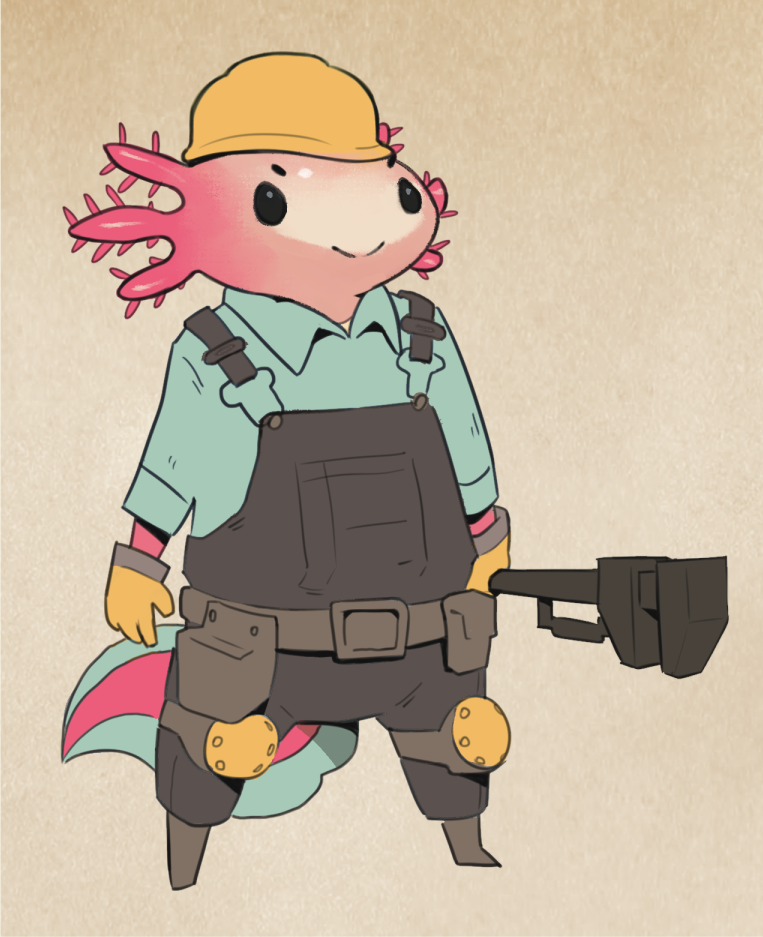 |
| Britzmark. I originally found this image on tumblr but this artist has deleted theirs. |
However, your species does still open up some unique opportunities to you. If you seek out someone who has followed this path before you, you might be able to find someone that knows a species-specific martial art.
These usually incorporate the unique biology of a species in some way or another, and will grant an ability at the expense of some sort of opportunity cost. I've written some up below, in the format of Species Ability - Training Duration - Restrictions, but adjust them to use as you see fit. And for heaven's sake, write some of your own.
Dragonborn - Voice of Rimhr
"And lo, our GodoG was once a peaceful being, who promised us sweet paradise on this earth and beyond it. But we were corrupt, and we sinned against HimiH, and we fell to bitter fratricide and enslavement. And thus, our GodoG-NameD-RimhR burned HisiH voice to ash, so that we may instead speak in a purifying flame."
Ability: As a standard action, you may breathe flame in a cone directly in front of you, dealing 1d6 damage for each level you possess (capped at 4d6) to everything in the area and lighting about half of the loose/flammable objects alight (the GM chooses based on what would be most interesting), save for half. If you use this ability again before you have had the chance to eat more of your rations and re-stabilize your inner flame (takes at least the duration of a short rest), you also take this damage. Additionally, you can always start a fire.
Training Duration: Six months, with regular practice afterwards. Dragons don't have a lot of free time.
Restrictions: Your diet must consist of primarily flammable things - mostly, lots and lots of oil. Your rations cost twice as much and are vulnerable to being destroyed when you take fire damage, like a scroll would be. Additionally, you have disadvantage on all nausea-based saves - that stuff doesn't stay down easy.
Drow - Arachnopotheosis
"We are the firstborn of Iuedaiya, and so it falls to us to uphold this community - no matter how many hands it takes."
Ability: At the beginning of your turn, you may sprout four extra arms. This grants you +4 attack and +4 inventory slots for the remainder of the combat (or, if used in less strenuous circumstances, an hour). This ability refreshes every new moon.
Training Duration: Eight weeks and access to two sets of mechanical "practice arms," which are ubiquitous in Underdark cities and basically nowhere else.
Restrictions: You have -1 attack and -1 inventory slot during the day, which you must fast through (so no consuming rations during daytime rests, either). Insects also hate you unconditionally.
If you are a human, you have a 10% chance of possessing the appropriate biology to be able to learn a species-specific fighting art. This is less a genetics thing and more to do with fleshcrafting - humans are not a naturally-occurring species, and instead have been "discovered" in multiple eras by multiple different fleshcrafters as the exact middle point between all sentient species. They're a useful base to work off of. This is also why the term "humanoid" exists.
Aside from that, the only way to learn the fighting arts of species you don't belong to is to become a Rykian Barber.
GLOG Class: The Rykian Barber (Xenomonk)
Rykian Barbers, adherents to the old god Rykus, are a usually-maligned group of monks, and so their monasteries are located primarily within the hinterlands of any given society. One of the few places where this is not the case is within Hazzem's Rikolese Empire, where practical and aesthetic fleshcrafting are deeply ingrained within the culture. Rykian Barbers are mostly nice and do the typical monk things of archiving religious texts and healing travelers for free, but if you die within their walls, your family will not get your body back.
Xenomonk A: Barber, Autocanopic
Xenomonk B: Student's Tongue, Student's Uniform
Xenomonk C: Blisternode, Rykian Conflagration
Xenomonk D: Allocanopic
Starting Skill [1d3]: 1 = Archivist, 2 = Personal Stylist, 3 = Necromancer
You begin play with an adjustable-size scalpel (1d6), burgundy robes, three doses of desiccating powder (dries and preserves organs until exposed to water), and a begging bowl.
Barber: You gain the Barber skill at rank 2. This skill can be useful to heal longer-term injuries, or even suppress spiritual or mental illness with access to the right ingredients.
Autocanopic: You may make a Barber skill check to harvest exotic organs from felled creatures. On its own, this does nothing except provide as a potential source of income (and if you've been doing this for awhile, you probably know somebody who wants monster or people bits).
However, you can also make a Will check during your downtime to sew these bits into yourself (you may gain +4 to the check if you get someone else with the Barber skill to help you). You may have a maximum number of organs transplanted this way equal to your level in this class (maximum 4). This allows you to learn fighting arts typically restricted to other species, provided you can find someone willing to teach you.
Even non-sentient species, or those considered "less civilized" (think ogres or demons) will usually have a species-specific fighting art, though finding someone to train you in it may be significantly harder (you might even have to seek out a high-level Rykian Barber to do so).
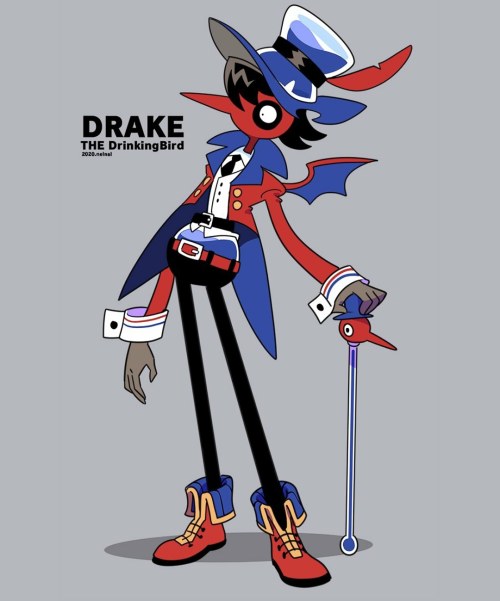 |
| Nelnal. Obviously, Xenomonks have the capacity for incredible fashion power. |
Student's Tongue: You may now use your Autocanopic ability on the tongues of other species, requiring the same Barber check to harvest and Will check to transplant. This allows you to speak the language at rank 5 - pretty much fluently, but lacking cultural context. This newfound language proficiency will only last you 24 hours, so use it wisely.
Student's Uniform: You may also use Autocanopic to masquerade as another species, which consumes the whole carcass (minus any other harvested organs). This requires a Barber check, but not a Will check (you're not transplanting anything). Again, your disguise will last 24 hours.
Sidebar: The two above abilities are primarily useful for finding a master for a species-specific fighting art, as these abilities are usually spiritual and wouldn't be shared with outsiders, if it were even (normally) possible.
Blisternode: Your extraneous organs have no more space to fit in your body, so you have installed a large "blister" in yourself to fit more. It swims under your flesh in an unsettling manner. Whenever you take damage from an attack, you may intercept it with the blister, sacrificing one of your currently-transplanted organs to reduce the damage taken by 1d6.
Feel free to change the flavor on this ability, because it's kind of fucking gross. But this whole class also is.
Rykian Conflagration: When you activate a species-specific technique, you may choose to "burn through" the organ, pushing it to the limits of its biological capabilities. This destroys the organ, deals 1d6 damage to you, and empowers the ability in some way. Work with your GM to figure out what this means - the possibilities are too wide to codify this.
If you have more samples of the organ, it is of course possible to reinstall them, and you don't have to go through the training process again if you do.
Allocanpic: Autocanopic, Student's Tongue, and Student's Uniform can now be used on other people. A non-Xenomonk person can only hold one extraneous organ (usually in place of their appendix, which is usually how they pay you for services rendered). These installations usually take around four hours each - longer than the usual self-transplant, since their bodies aren't as used to the physical trauma and need a longer recovery period.
Wimps.
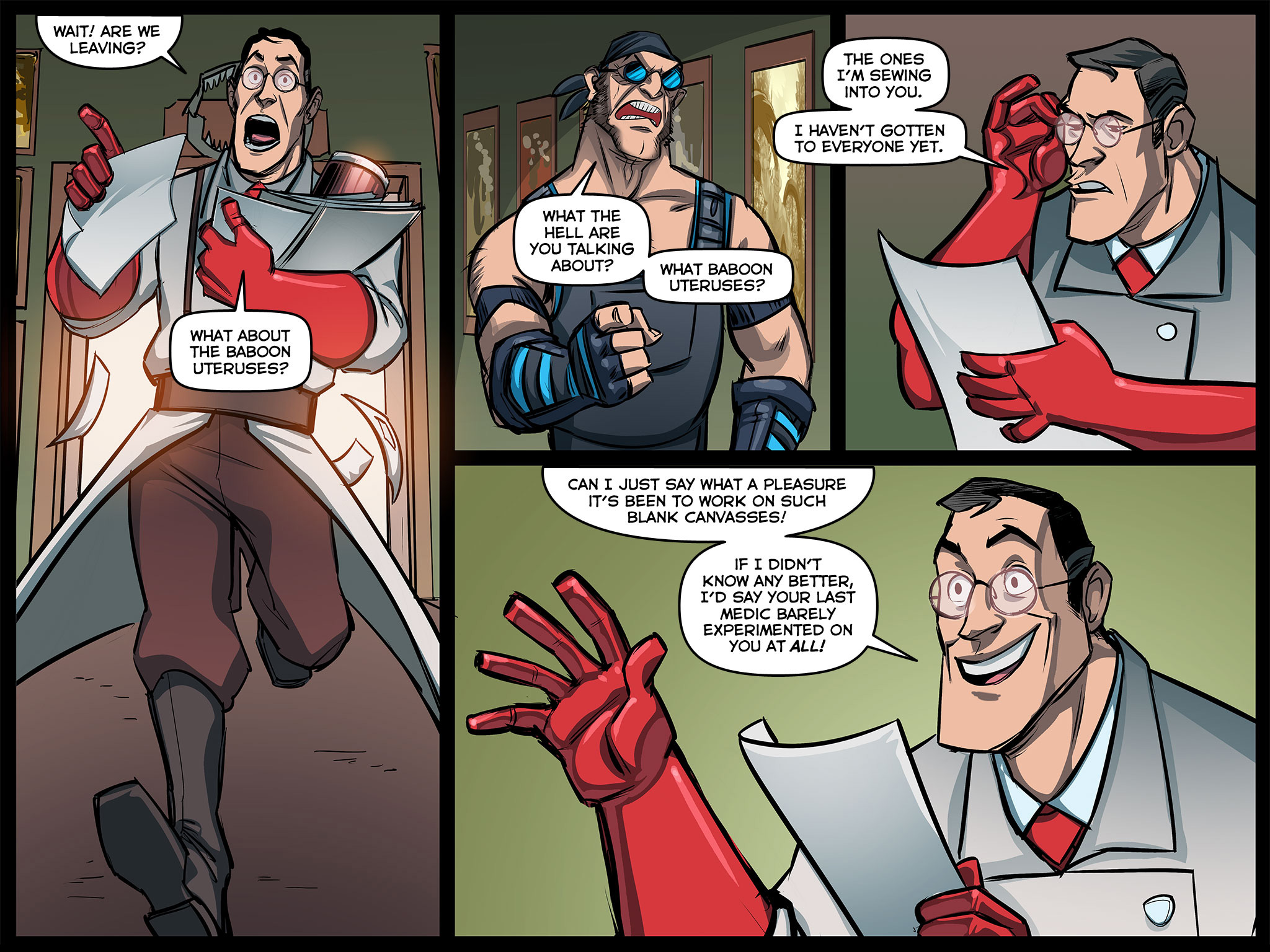 |
| TF2 Comics. Medic is obviously a Xenomonk. |
Closing Thoughts
Design-wise, this class is like a more gore-y version of the Reliquarian. Lately I've just really been enjoying designing classes that incentivize looking for a specific thing. It's what makes some of the classic classes great - Wizards keep an eye out for scrolls, Fighters keep a lookout for really good swords, and Thieves look for easy marks. It helps push player ambition and GM design space.
Big thanks to Magnus, who suggested Blisternode and Rykian Conflagration, which was what I needed to finally get off my ass and finish writing this. It's kind of brilliant - right as you start to have a lot more options in what organs you can haul around in you, you also get incentivized to give up your current ones in exchange for new ones.
And also thanks to everyone who helped me in the process of writing this, whose twitters I've included links to above. They don't really post much TTRPG content, but they have good ideas and that is worth crediting.
Finally, these rules and the Xenomonk were written in reference to my own rules for skills and stuff. They should be pretty compatible with most GLOG permutations, but I'll probably post my personal GLOGhack rules here sometime.