Tuesday, September 8, 2020

GLOG Rules/Class: Species-Based Abilities and the Xenomonk

D&D and Race


"Race" is a pretty pervasive concept within tabletop games, both mechanically and narratively. Unsurprisingly, people love some elves in their elfgame. But D&D (in specific, though this conversation could certainly extend to many other sword-and-sorcery systems) has been catching more and more flak as of late for the colonial undertones race presents. Alignment is a particular sticking point there, but my thoughts on alignment have already been documented.

Behold Her has a great episode on decolonizing D&D, which brings this issue up from a narrative standpoint. It's a great thing for any GM to listen to, especially if you're white and worried about creating upsetting scenarios for your players of color. Thanks goes out to my friend and fellow-GM Sam for recommending this episode to me.

However, the idea of "race" still creates problems on a mechanical level. If we're just viewing this within the context of the game, I'd call it an issue of system bloat. Races have abilities because they "have to," and also to feel different. This is especially a problem in D&D, where it's created long-lasting synergies that make certain builds very common. 

Regardless of how you feel about "builds" in tabletop games, this phenomenon is antithetical to the design goal of making races "feel different." Your half-elven bard, or halfing rogue, or especially your human fighter actually feels less unique, because that's already been done so often.

And if we look at this from outside the perspective of the game, it still has a lot of colonial undertones. I was made most acutely aware of this during an anthropology class, of all things. We were looking at a chart related to the Four Humours theory, and specifically one that postulated that each "race" (really broad-scale ethnicity - people from Europe, East Asia, Africa, and Indigenous Americans) had too many of one of the humours.

As the theory went, this led each race to have certain strengths and weaknesses. Europeans were smart and creative, but overly sensitive. Meanwhile, Africans were inherently strong but also naturally lazy and less intelligent - that sort of thing.

This left a particularly bad taste in my mouth because I realized "oh, shit, this feels like I'm flipping through the PHB."

Clearly, something had to change.

Bloodborne McGee.


Tabletop and Species


Here's what I arrived at:

First off, let's not call these "races." The idea of race is a societal construction that's existed for centuries for the explicit purpose of oppressing people and justifying violence against them. Although the idea has been somewhat reclaimed in modern times - and something being a societal construction doesn't even mean it's less real - the term is especially distasteful in the context of medieval settings rife with imperialism and slavery.

Moreover, it's not very accurate. The classical drow, dwarves, and dragonborn are much closer to distinct species than genetic variations on a single type of organism. I'm sure if you were more studied than I was in biology there could be an argument here, but frankly I enjoy my science as far away as possible from my elfgames.

So, let's call them species. I know that's what I'll be doing from here on in article. I should also, again, give props to the friend that got me doing this initially - another fellow GM, Ace.

As for how to back them up mechanically, my current favorite answer is to just not do that at all. It bogs down character creation with unnecessary choices (a particular hazard for one-shots) and can quickly slip back into uncomfortable colonial-thought territory.

Of course, in some cases it just makes sense to allow stuff - yeah, of course the gnome can fit into the vent shaft, sie's small. Or, sure, the techno-person can interface with the ancient magitech computer, but can you roll me a Will save against a dormant arcanovirus? Just approach it the way Background does in LANCER - either the player or the GM can invoke a player's species to make checks easier or harder.

If you happen to be playing or designing a crunchy system, where you want the additional complexity and synergy-opportunity, just let your players start with some feats (or whatever the equivalent is). That makes it so who they are is still mechanically important, but "who they are" isn't just their genetics.

But there's "GLOG" in the title to this post, isn't there?

Goblin Arts of Gaming


Consider the next half of this post to be a very extended Joesky Tax.

For a system designed to be pick-up-and-play and with an emphasis of getting unique abilities and items outside of the normal leveling structure, the GLOG is a unique opportunity to approach species as a concept. I've yet to playtest this, but here's what I'm thinking:

Species, by default, have no real abilities. As mentioned above, there might be some invoking of species where appropriate, but there's no bonuses to ability scores or unique actions. Sure, you're an axolotlfolk or whatever, but chiefly you're a person.
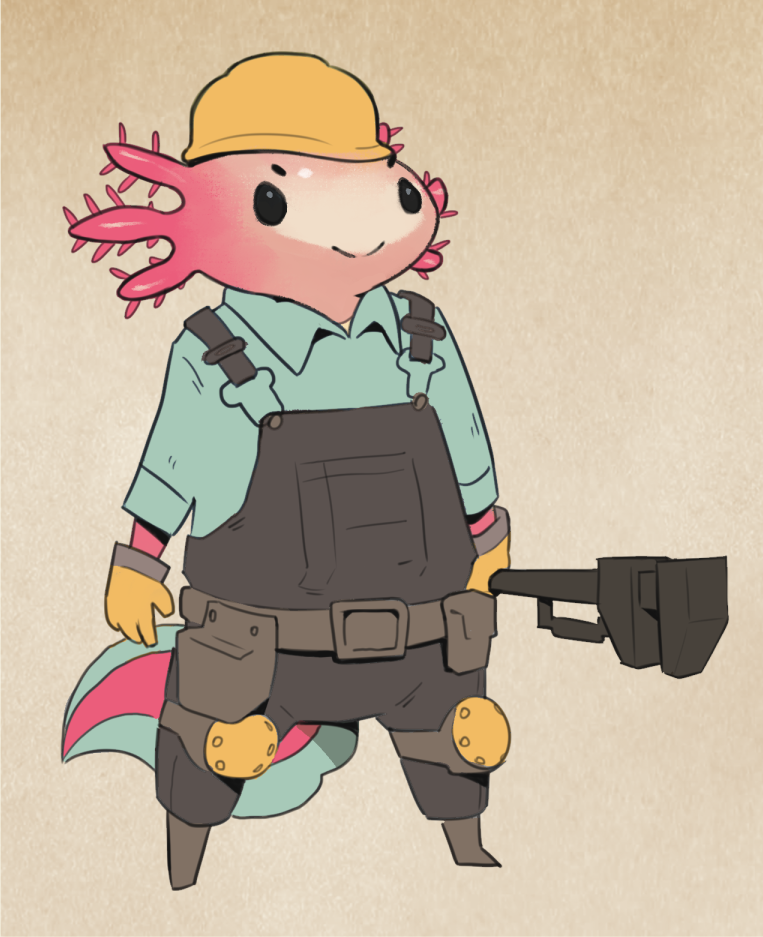
Britzmark. I originally found this image on tumblr but this artist has deleted theirs.


However, your species does still open up some unique opportunities to you. If you seek out someone who has followed this path before you, you might be able to find someone that knows a species-specific martial art.

These usually incorporate the unique biology of a species in some way or another, and will grant an ability at the expense of some sort of opportunity cost. I've written some up below, in the format of Species Ability - Training Duration - Restrictions, but adjust them to use as you see fit. And for heaven's sake, write some of your own.

Dragonborn - Voice of Rimhr
"And lo, our GodoG was once a peaceful being, who promised us sweet paradise on this earth and beyond it. But we were corrupt, and we sinned against HimiH, and we fell to bitter fratricide and enslavement. And thus, our GodoG-NameD-RimhR burned HisiH voice to ash, so that we may instead speak in a purifying flame."
Ability: As a standard action, you may breathe flame in a cone directly in front of you, dealing 1d6 damage for each level you possess (capped at 4d6) to everything in the area and lighting about half of the loose/flammable objects alight (the GM chooses based on what would be most interesting), save for half. If you use this ability again before you have had the chance to eat more of your rations and re-stabilize your inner flame (takes at least the duration of a short rest), you also take this damage. Additionally, you can always start a fire.
Training Duration: Six months, with regular practice afterwards. Dragons don't have a lot of free time.
Restrictions: Your diet must consist of primarily flammable things - mostly, lots and lots of oil. Your rations cost twice as much and are vulnerable to being destroyed when you take fire damage, like a scroll would be. Additionally, you have disadvantage on all nausea-based saves - that stuff doesn't stay down easy.

Drow - Arachnopotheosis
"We are the firstborn of Iuedaiya, and so it falls to us to uphold this community - no matter how many hands it takes."
Ability: At the beginning of your turn, you may sprout four extra arms. This grants you +4 attack and +4 inventory slots for the remainder of the combat (or, if used in less strenuous circumstances, an hour). This ability refreshes every new moon.
Training Duration: Eight weeks and access to two sets of mechanical "practice arms," which are ubiquitous in Underdark cities and basically nowhere else.
Restrictions: You have -1 attack and -1 inventory slot during the day, which you must fast through (so no consuming rations during daytime rests, either). Insects also hate you unconditionally.

If you are a human, you have a 10% chance of possessing the appropriate biology to be able to learn a species-specific fighting art. This is less a genetics thing and more to do with fleshcrafting - humans are not a naturally-occurring species, and instead have been "discovered" in multiple eras by multiple different fleshcrafters as the exact middle point between all sentient species. They're a useful base to work off of. This is also why the term "humanoid" exists.

Aside from that, the only way to learn the fighting arts of species you don't belong to is to become a Rykian Barber.

GLOG Class: The Rykian Barber (Xenomonk)


Rykian Barbers, adherents to the old god Rykus, are a usually-maligned group of monks, and so their monasteries are located primarily within the hinterlands of any given society. One of the few places where this is not the case is within Hazzem's Rikolese Empire, where practical and aesthetic fleshcrafting are deeply ingrained within the culture. Rykian Barbers are mostly nice and do the typical monk things of archiving religious texts and healing travelers for free, but if you die within their walls, your family will not get your body back.

Xenomonk A: Barber, Autocanopic
Xenomonk B: Student's Tongue, Student's Uniform
Xenomonk C: Blisternode, Rykian Conflagration
Xenomonk D: Allocanopic

Starting Skill [1d3]: 1 = Archivist, 2 = Personal Stylist, 3 = Necromancer

You begin play with an adjustable-size scalpel (1d6), burgundy robes, three doses of desiccating powder (dries and preserves organs until exposed to water), and a begging bowl.

Barber: You gain the Barber skill at rank 2. This skill can be useful to heal longer-term injuries, or even suppress spiritual or mental illness with access to the right ingredients.

Autocanopic: You may make a Barber skill check to harvest exotic organs from felled creatures. On its own, this does nothing except provide as a potential source of income (and if you've been doing this for awhile, you probably know somebody who wants monster or people bits).

However, you can also make a Will check during your downtime to sew these bits into yourself (you may gain +4 to the check if you get someone else with the Barber skill to help you). You may have a maximum number of organs transplanted this way equal to your level in this class (maximum 4). This allows you to learn fighting arts typically restricted to other species, provided you can find someone willing to teach you.

Even non-sentient species, or those considered "less civilized" (think ogres or demons) will usually have a species-specific fighting art, though finding someone to train you in it may be significantly harder (you might even have to seek out a high-level Rykian Barber to do so).
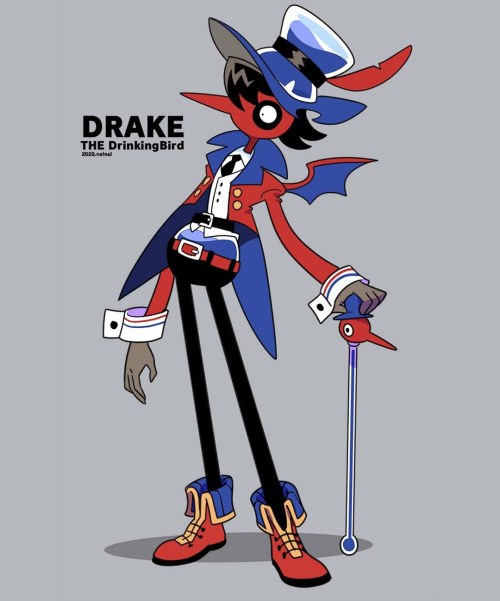
Nelnal. Obviously, Xenomonks have the capacity for incredible fashion power.


Student's Tongue: You may now use your Autocanopic ability on the tongues of other species, requiring the same Barber check to harvest and Will check to transplant. This allows you to speak the language at rank 5 - pretty much fluently, but lacking cultural context. This newfound language proficiency will only last you 24 hours, so use it wisely.

Student's Uniform: You may also use Autocanopic to masquerade as another species, which consumes the whole carcass (minus any other harvested organs). This requires a Barber check, but not a Will check (you're not transplanting anything). Again, your disguise will last 24 hours.

Sidebar: The two above abilities are primarily useful for finding a master for a species-specific fighting art, as these abilities are usually spiritual and wouldn't be shared with outsiders, if it were even (normally) possible.

Blisternode: Your extraneous organs have no more space to fit in your body, so you have installed a large "blister" in yourself to fit more. It swims under your flesh in an unsettling manner. Whenever you take damage from an attack, you may intercept it with the blister, sacrificing one of your currently-transplanted organs to reduce the damage taken by 1d6.

Feel free to change the flavor on this ability, because it's kind of fucking gross. But this whole class also is.

Rykian Conflagration: When you activate a species-specific technique, you may choose to "burn through" the organ, pushing it to the limits of its biological capabilities. This destroys the organ, deals 1d6 damage to you, and empowers the ability in some way. Work with your GM to figure out what this means - the possibilities are too wide to codify this.

If you have more samples of the organ, it is of course possible to reinstall them, and you don't have to go through the training process again if you do.

Allocanpic: Autocanopic, Student's Tongue, and Student's Uniform can now be used on other people. A non-Xenomonk person can only hold one extraneous organ (usually in place of their appendix, which is usually how they pay you for services rendered). These installations usually take around four hours each - longer than the usual self-transplant, since their bodies aren't as used to the physical trauma and need a longer recovery period.

Wimps.
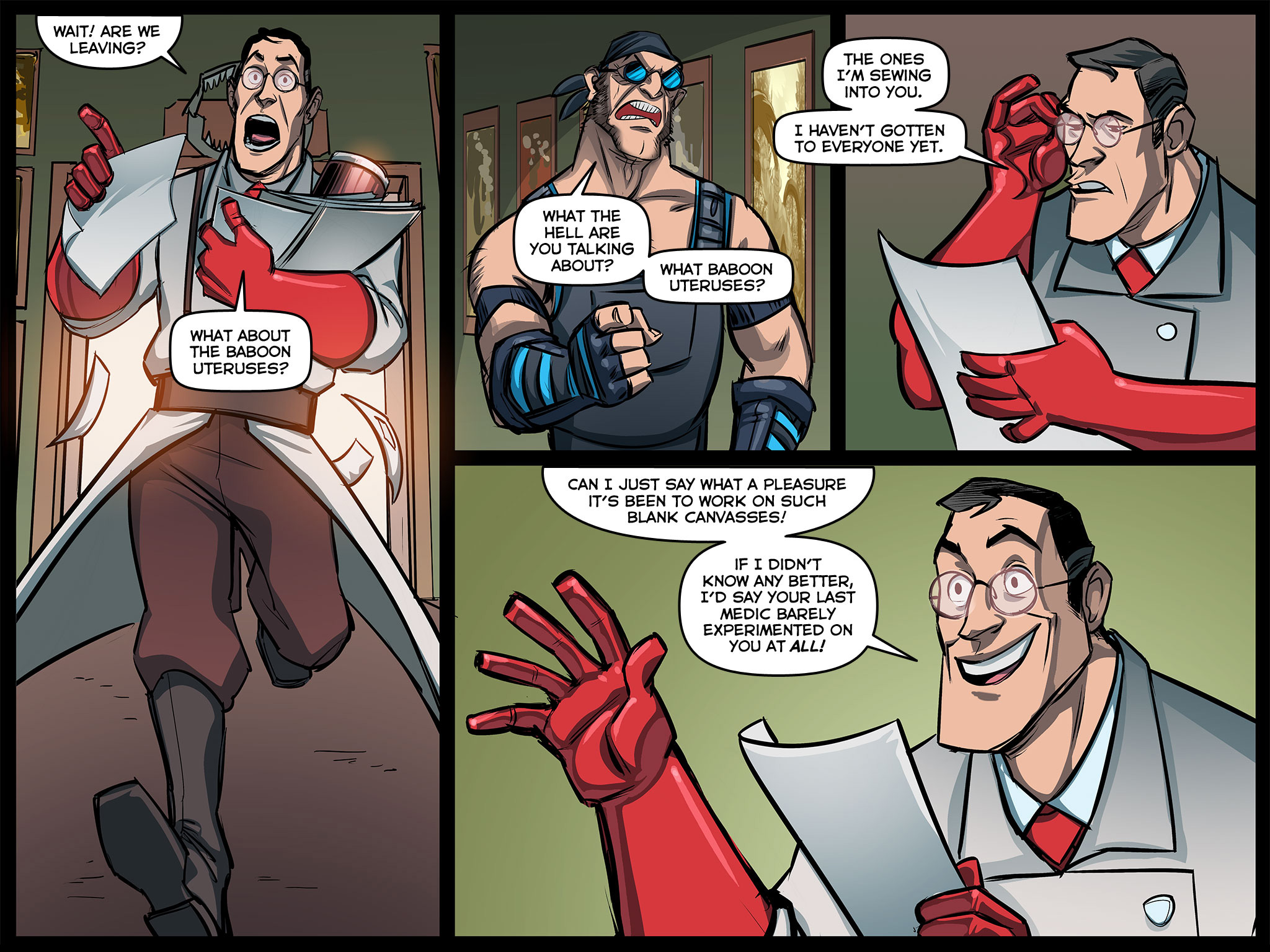
TF2 Comics. Medic is obviously a Xenomonk.


Closing Thoughts


Design-wise, this class is like a more gore-y version of the Reliquarian. Lately I've just really been enjoying designing classes that incentivize looking for a specific thing. It's what makes some of the classic classes great - Wizards keep an eye out for scrolls, Fighters keep a lookout for really good swords, and Thieves look for easy marks. It helps push player ambition and GM design space.

Big thanks to Magnus, who suggested Blisternode and Rykian Conflagration, which was what I needed to finally get off my ass and finish writing this. It's kind of brilliant - right as you start to have a lot more options in what organs you can haul around in you, you also get incentivized to give up your current ones in exchange for new ones.

And also thanks to everyone who helped me in the process of writing this, whose twitters I've included links to above. They don't really post much TTRPG content, but they have good ideas and that is worth crediting.

Finally, these rules and the Xenomonk were written in reference to my own rules for skills and stuff. They should be pretty compatible with most GLOG permutations, but I'll probably post my personal GLOGhack rules here sometime.

Thursday, May 28, 2020

Dueling Rules

I've been spending a lot of time in Chris McDowall's OSR discord as of late. A few days ago, people were talking about Wild/Weird West games. This reminded me that I actually have some rules for gun duels hanging around, so I figured I'd publish them.

These aren't playtested, but I plan to run a pirate-themed game soon and I can probably work them into there.

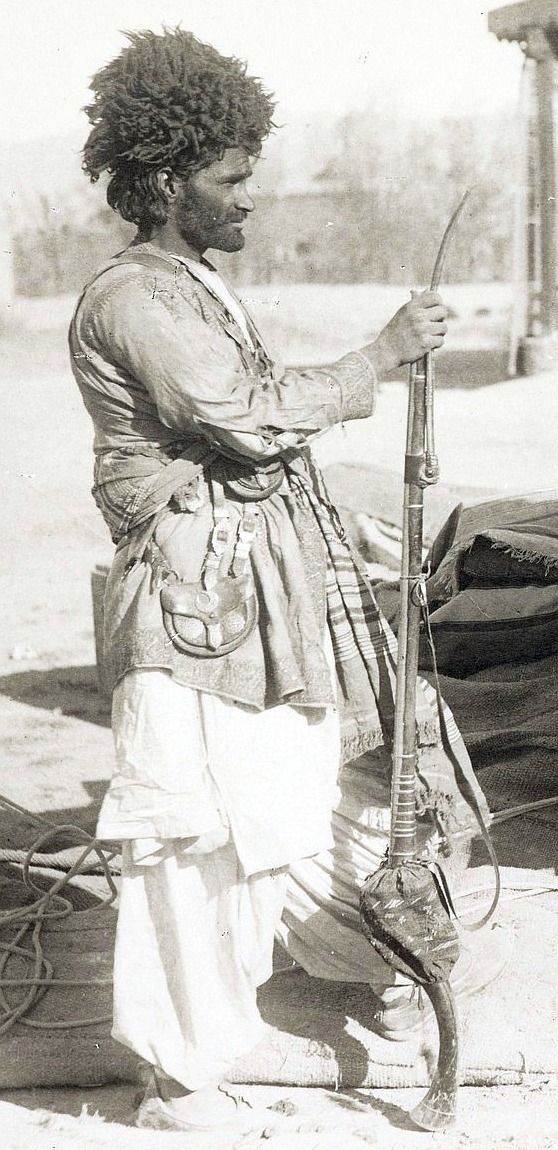
Couldn't find a source for this image.
In Karcena, a jezail doesn't earn that title until it sees you through a duel.

First off - dueling is not combat. There's no initiative. Duels are always agreed upon, and though the customs for how to initiate them differ they always come down to a combination of speed, aim, and luck.

If you're "dueling" someone who hasn't agreed to your terms beforehand, that's just combat.

Dueling is, however, still fatal. Refusing to shoot your opponent has no real mechanical effect, but might earn you reputation depending on where you are. If a PC is going to engage in a duel, give them the same amount of heads-up you would for a save-or-die effect.

Here's the basic gist of the ruleset (heavily inspired by Warrior Poet):

  1. Arrange the duel.
  2. Meet at the location all duelists agreed upon.
  3. Exchange final words before the duel; offers to de-escalate, formalities, or smack-talk.
  4. Square up. This is your last chance to declare that you aren't shooting to kill.
  5. Each party in the duel rolls an amount of d6s that depends on their circumstances. 
  6. Add all your d6s together to get the sum of your rolls.
  7. The party with the highest sum may automatically hit their target, doing so before their opponent's shot connects. This may be a killing blow, if that party wishes. That party narrates the shot.
  8. If another party's sum is within 3 of yours, you sustain a gunshot wound (take damage as though hit with an attack from that gun, plus remember infections exist).
  9. If any party is killed, they give their last words.

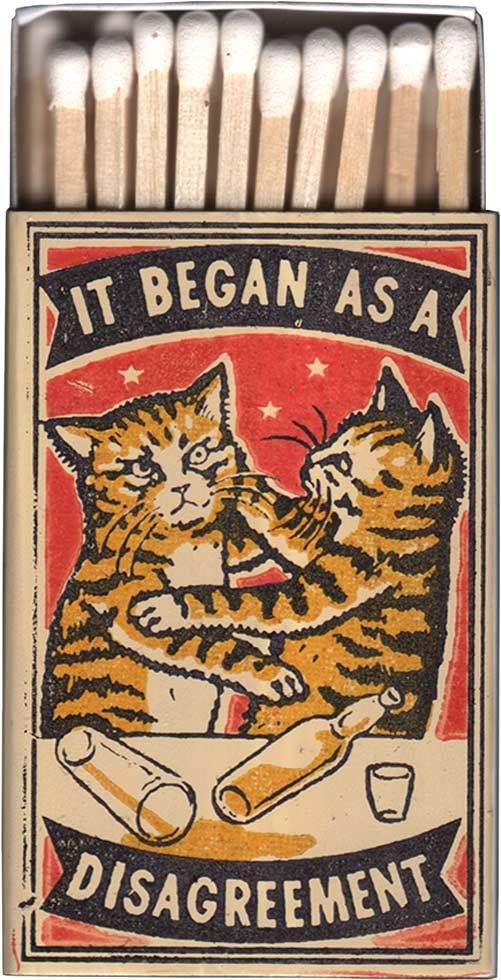
Arna Miller and Ravi Zupa. Those are the artists, for the record - not the cats.


As mentioned, you can add more d6s to your pool under certain circumstances.

GAIN EXTRA D6s FOR:

  1. Having a higher Ability Score than your opponent. You must justify how this helps you; "I've drawn a crowd, and my higher Charisma prevents stage fright." "My Wisdom is higher than hers - I ain't afraid, and I won't hesitate when it comes time to shoot." Your DM has the final say on whether this counts or not.
  2. Better smack-talk before the duel than your opponent; vote among the DM and any non-involved NPCs.
  3. Strategic positioning: you're in the shadow of the saloon, whereas your opponent is in broad daylight.
  4. Anything else your DM okays.

LOSE D6s FOR:
  1. Deciding to not shoot to kill.
  2. Being drunk. Dwarves or other hardy species might be exempt from this. Hell, you might even get better at dueling while drunk depending on class.
  3. Using a weapon your opponent rigged. Always mix your own powder, and keep your gun at your hip or under your pillow.
  4. Any other penalty your DM assigns.

---


As I mentioned previously, Warrior Poet is a really good system. The feeling of being immensely powerful (and getting extra d6s) because you're fighting during your season is great, and the fact that it builds toward a narrative that you build with your fellow players is fantastic. I tried to capture a little bit of that here.

I know there are a bunch of GLOG classes that can issue a challenge as a class ability, which out-of-combat will result in a duel. These rules work well for that if you're in a setting where dueling pistols are appropriate. It probably isn't bad for duels with swords either, just take away the ability to instakill your opponent and have a few different rounds of rolling.

If I ever write a gunslinger class, it'll reference these rules.

Sunday, May 24, 2020

GLOG Class: Reliquarian

Well, I finally bit the bullet and played a GLOG game. Unsurprisingly, it was very good.

Here's an attempt at writing my old idea for a Wizard replacement for the GLOG.

The Reliquarian


You are a magician, but before that you are a merchant. You come from some line of work that involves passing the eyes over what people deem "valuable." In your time, you've learned that they're usually wrong. Value is only wrenched from the ribcage of some horrible dungeon that's teeming with unsightly critters. 

Juanmao


Reliquarian A: Appraisal, Spellcasting, Relics
Reliquarian B: Contemporaries
Reliquarian C: +1 MD
Reliquarian D: Cabinet of Curiosities

Starting Skills [1d3]: 1 = Anthropologist, 2 = Caravaner, 3 = Gambler

You begin play with a knife, a quill with ink, and a ledger detailing your previous expenditures and business dealings. You also have one Relic from the Relic Table, determined by rolling a d4.

Appraisal: You can discern the exact value of a mundane object if you touch, smell, and taste it for one minute. If the item is either magical or of cultural value, you learn as such instead of its value.

Spellcasting: You have a pool of Magic Dice, all of which are d6s. You use these to cast spells. Whenever you cast a spell, roll any number of d6s. A result of 1-3 returns the die to your casting pool. A result of 4-6 expends the die until the next time you sleep. Some spells care about the number of [dice] invested, others care about the [sum] of all the dice you roll. 

At first level, you have one Magic Die. You may invest your Magic Dice into spell scrolls or Relics.

At higher levels, you will gain more Magic Dice. If you ever invest more than one Magic Die into a Relic, and both dice show the same number, you suffer a Mishap according to which Relic you were using.

Relics: Whenever you find money in a dungeon or get paid for doing a mission, you may replace your share of that money (1/4th of it in a party of four, 1/6th of it in a party of six, ect.) with a Relic, as rolled on the table below. Remember that money is XP - and choosing to acquire a relic does not award you XP equal to its copper/gold/whatever value.

You do the calculations for finding Relics, because the DM has enough on their mind. 

Contemporaries: You have found someone within the city of your choice that will buy your Relics. A Relic's value is determined by what fifth of the Relic Table it's on. Relics 1-4 on the list are worth 100 copper, Relics 13-16 are worth 400, that kind of thing. Obtaining money this way still doesn't gain you XP.

The first time you spend at least a week doing non-adventurous things in a new city, you will discover another Contemporary in that city.

Cabinet of Curiosities: Whenever you finish a rest, you may gift any number of people who were resting with you one of your Relics. They may now use that Relic, and gain one Magic Die that can only be used to use the specific Relic that you gave them.

If you give that Relic to another Reliquarian, they permanently gain one Magic Die. If you gift a Relic to one of your Contemporaries, they will be emboldened enough to join you as a hireling on your next mission.

cy-lindric


THE RELIC TABLE
(For the purposes of this table, when I say "copper" I just mean the standard coinage - the equivalent of a dollar - in your setting.)

Why does Blogger lack a table function?

It might also be possible to buy these relics in a city, but the people selling them are most likely lying to you and definitely unsavory. Ask your DM.

Sophie Woodrow

1. Comb of the Imp-eror: Deal [dice] damage to any target you can see, no save. You can instead pull your hair with the comb to deal [sum] damage to your target and yourself.
2. Clam-God's Progeny: Can hold any opening closed for [sum] rounds. 
3. Tail of the First Rat: Tether two targets together (the weakest unwilling target gets a Save). Those targets cannot move more than 4-[dice] feet apart.
4. Tongue of the Mute Saint: Those that can hear you believe up to [dice] lies you speak until given reason to believe otherwise. You take [sum] damage.

5. Steel Plum: Petrify any target for [sum] rounds. Lethal if the target is a creature with HD lower than [dice]. Petrified targets are otherwise immune to all damage.
6. Antlers of a Wild God: Heal any creature [sum] HP over [dice] rounds. That creature has antlers for the duration. Hostile enemies will only target that creature for the duration, and religious folks will see this as blasphemy. 
7. Pickled Quasit: Summon a 1 HD Quasit to do your bidding for [dice] hours. Your Quasit has [sum] morale, as a hireling.
8. Petrified Dung Beetle: Summon tentacles of an unfathomable elder god to flay any target within 15 ft. for [sum] damage. If that target fails a save, they take an additional [dice] damage and fall prone. 

9. Croaking Trumpet: Summon a Belcher up to [sum]x10 feet away.
10. Shadowfell Reading Candle: Light a 20ft. area on fire for [sum] rounds. Targets and objects in the area take [dice] damage at the beginning of each of their turns, unless an action is used to put the target out. The flame is a brilliant white.
11. Knotted Rope Earring: You can create an unbreakable rope [sum]x10 feet long. It lasts for [dice] minutes.
12. Golden Monkey Head: Does nothing. Upon activation, will be seen as worth [sum]x100 copper for [dice] hours.

13. Inexplicable Dodecahedron: Target creature's fumble range increases by [sum] for [dice] rounds. 
14. Oozemonger's Flask: Turn one arm into a slimey psuedopod for [dice] rounds. You may attack with it for [sum] damage. Your attacks with this arm ignore armor. The arm is useless for anything else, except perhaps dissolving small objects. After using this Relic you may immediately make an attack with the arm. 
15. Fishman's Hat: Upon activation, you can breathe water for [dice] hours. For the duration, air-breathing strangers are violently xenophobic towards you.
16. Lonesome Bride's Veil: As long as you are not currently with other party members, hirelings, or friendly NPCs, you become invisible for [sum] rounds. The current duration shortens to [dice] rounds if you move, attack, or cast spells. 

17. Dracogod Dagger: Deal [dice] damage to a creature within 5 ft. If this kills the target, their blood crystallizes into darts and seeks out a target of your choice within 60 ft., dealing [sum] damage. If this kills the target, repeat. You do not have the option of choosing nobody. 
18. Sea God's Decanter: After activation, can summon ten gallons of saltwater every round it's uncorked. Lasts for [sum] rounds. If used to make an attack roll, it has a range of 30 ft., deals [dice] damage and pushes the target [dice]x10 feet.
19. Pixie's Anvil: Create a wall [sum]x5 feet long and [dice]x10 feet high. This wall is always five feet thick and made of ivy-choked stone. You must place the wall within 60 ft. of yourself.
20. Reading Glasses of the Royal Tutor: You may change [dice] sentences within a book of your choice to say something of roughly equivalent length. You must have a copy of the book available when casting this spell. This Relic changes the text within all copies of that book.

MISHAPS

Whenever you roll the same number twice while casting as a Reliquarian, you suffer a Mishap. The Mishap you suffer depends on the Relic you were using.

If you suffer a Mishap while using a scroll, your Magic Dice only refund on a roll of 1-2 until the next time you sleep.

1. Comb of the Imp-eror. Your hair grows to heel-length and starts grappling you. Its grappling ability is based off of your own.
2. Clam-God's Progeny. Your mouth snaps closed for [sum] rounds instead of the actual target.
3. Tail of the First Rat. You are tethered to the strongest of the two targets instead. If you are farther than the length of the tether, you are yanked towards them.
4. Tongue of the Mute Saint. You immediately say something true that negatively impacts you or your party. At best, you admit to the whole village that you can't tie your shoes, at worst you tell the bandits where the prince you're escorting is.
5. Steel Plum. Your casting arm is petrified for [sum] rounds instead of the target, becoming useless.
6. Antlers of the Wild God. You grow antlers for [dice] days. This marks you as a worshipper of a Wild God. All wise churches will spurn you.
7. Pickled Quasit. Instead summon a hostile 1 HD Quasit for [sum] rounds.
8. Petrified Dung Beetle. You are instead flayed for [sum] damage.
9. Croaking Trumpet. Summon a Belcher directly on top of yourself.
10. Shadowfell Reading Candle. You also burst into flame, taking [dice] damage at the beginning of each turn unless put out. Each turn, the flame spreads to one of your items.
11. Knotted Rope Earring. The rope is still created, but it is tied around your neck and planted firmly in the earth directly beneath you.
12. Golden Monkey Head. One random object within your inventory becomes worthless permanently. Swords will become chalk, gems will become mud.
13. Inexplicable Dodecahedron. Your fumble range expands by [sum] for [dice] rounds instead of the target's.
14. Oozemonger's Flask. You transform entirely into an ooze for [dice] rounds. You move at half speed, can't use items, and can communicate only in burps. You still deal [sum] acid damage.
15. Fishman's Hat. Water-breathing strangers are also violently xenophobic towards you.
16. Lonesome Bride's Veil. Your party forgets you exist for the duration.
17. Dracogod Dagger. Make the initial attack, but if it kills the target their crystallized blood instead targets you.
18. Sea God's Decanter. The current room fills with saltwater over the course of one round. If you aren't currently in a room, [sum] gallons of saltwater are spontaneously dumped on your head.
19. Pixie's Anvil. The wall is instead made of delicious sugar candy.
20. Reading Glasses of the Royal Tutor. The targeted sentences are instead changed to spill your greatest secret. The more sentences targeted, the greater into detail it goes.

---

Discussion


This is my first real crack at writing a GLOG class. I've yet to playtest it.

It's adapted from my old take on the Wizard from my old attempt at a homebrew system. In that system you had to buy your level-ups, but I wanted the Wizard to scale off of finding weird magic shit as opposed to levels. I always thought that was a neat idea, so I adapted it some here. The GLOG has plenty of classes that mess with XP flow already.

That's also why the Reliquarian only ever gets two MD from levels. If you want more, seek out another experienced Reliquarian, or just be content gaining power in versatility. 

If you just wanna treat this as a d20 table of magic items, that's fine too.

Also, my friend Jodi started her own blog.

UPDATE: Added Mishaps because I forgot about them. Thanks to those in the OSR Discord for suggesting the idea of each Relic having its own Mishap, and thanks to Numbers Aren't Real for writing the first few to help kick-start that process.
UPDATE, AGAIN: Thanks to Arnold K. for recommending more interesting Mishaps.

Friday, April 24, 2020

Treasure Monsters


The Mimic is a great monster because the party's approach to dealing with it changes as they get better at the game.

The first time a Mimic bites your thief's arm off, players will know to be on the lookout for them going forward. Actually, it usually doesn't even take that long - most people with any sort of background in gaming know what a Mimic is, and whenever I have a treasure chest in a dungeon at least one of my players worries about a Mimic.

This is how the Mimic goes from Monster to Trap. It transforms from an encounter into a problem that can be solved with creative thinking. Give the Mimic some of your rations, or hit it with a sleep spell/potion, and you can take the contents of the chest and be on your merry way.

However, some players take it even further. Once your players realize that the Mimic can be subdued in this way, they realize that they can use it against other enemies in the dungeon. After feeding it, pick it up and move it into the room where you saw those goblins. Make a loud noise, hide, and watch the goblins get themselves eaten.

This is how the Mimic goes from Trap to Treasure. Other examples of this are spring-loaded poison needles that poke anyone getting tricky with a lock, or spears that jut from the walls when you step on a pressure plate, or any trap that you can trick monsters into walking into.

Monster, then Trap, then Treasure. The progression of a great monster. Let's try to write some. Explanation of system-agnostic statblocks here.

Scribblies


Scribblies come from wizard apprentices who die while carrying their masters' loose scrolls. They only form if not given a proper burial.

SIXMOREVODKA

Scribbly
HD 2 Size Small AC As zombie Speed As dwarf
Languages Common (Can speak, only understands written.)
Quill: Dodge 12, 1d6 

Scribe - Anytime a spell is cast within the Scribbly's line of sight, it automatically records that spell onto itself, as a scroll. Any given Scribbly in a dungeon will already have one spell recorded onto it. It can store as many spells as it has HD. When it dies, any spell still scribed onto it is recoverable as a scroll. You can also show a Scribbly a page of your spellbook or a loose scroll and it will scribe that spell onto itself. This makes it friendly.

What spell does this Scribbly already have scribed? (1d4)
1. Sleep
2. Fireball
3. Polymorph (into Gelatinous Cube)
4. Summon (Elephant)

Recitation - As an action, the Scribbly can recite a spell currently stored on it. This causes it to cast that spell on a random target within the spell's range, consuming that scroll. It automatically takes this action whenever it takes slashing, piercing, fire, or acid damage (or damage of any other type that would harm the scroll - it's screaming out "oh no, not the precious scroll of fireball!" which counts as the verbal component for that spell).

Discussion: I haven't playtested this, but I like the idea of it a lot. I would only put it in an area with other monsters, or at least put it near them. If you put it on a random encounter table, it could be something like "2d6 orcs and their warlock leader wander into a room with one Scribbly," or whatever.

I'm hoping the progression here is "fight it once without realizing what its deal is" > "figure out its deal and try to exploit it for a free scroll" > "load it up with a dangerous spell by showing it the wizard's spellbook and then get it to wander into a room full of stupid enemies."

I would also experiment with older Scribblies that have higher HD. Make them more resentful of their fate, and meaner. And also let them trim off pieces of themselves to summon lesser Scribblies mid-combat. Would probably make for a good boss monster.

Belcher


Belchers look kind of like blobfish and occupy a similar ecological niche as the mola mola: it just isn't worth the trouble of hunting down for anything to really bother eating it. They're actually really shitty air elementals, holdovers from an ancient underground civilization that saw air and fire as opposites. (On Loom, elementals are spirits that form from cultural conceptions of "the elements" - so yeah you have the water/fire/air/earth ones, but also Xenon Elementals, Feminine Energy Elementals, and Piss Elementals [goblins consider piss to be a core element].)

Hollow Knight

Belcher
HD 8 Size Medium AC As leather Speed As dwarf
Immunities Fire, Indigestion
Bite: Dodge 14, 1d6 + attached (detach check is DC 20 or whatever an unreasonably hard check is in your system.)

Dry Ice - The Belcher constantly vomits up vision-obscuring fog in a 30' radius around itself. If the Belcher is killed or leaves an area, its fog remains for a minute. Wind effects, unless continual, will only disperse the fog for a round.

Photophobic - Belchers will relentlessly attack light sources. They'll crawl up to explorers and eat their lantern(s). They only attack people if those people attack them.

Discussion: Belchers have a lot of health, and are a pain in the ass to kill. If you're trying to get past it, the best option is honestly to just douse your torch and move on. Or light up an arrow and shoot it down the hallway you just came from. Better yet if those manticores were still chasing you.

Again, I would only run these with actually threatening other monsters nearby. Or you could have it screech loudly when damaged, causing other nearby stuff to come investigate. 

There's also the option of tying it to a rope and dragging it around as a free fog cloud.

---

Update on Ability Scores, But Shitty:

I ran about half of The Meal of Oshregaal on Sunday with Deficiencies replacing Ability Scores and it went pretty alright. It definitely takes getting used to, and we didn't actually get into any combat, but I think it has promise. I didn't have any moments where we had to stop and go "wait, is this 18 good or bad" which I've seen happen a little bit with the GLOG. The whole thing might wind up being unnecessary, but we'll see. I think combat will be the real test.

Wednesday, April 15, 2020

Ability Scores, But Shitty


The Oblidisideryptch has a great GLOG-hacked system of "roll over your low ability scores" to overcome challenges, as opposed to the GLOG's usual deal of "high ability scores that you have to roll under."

This fixes what might be considered a fundamental problem with the GLOG - human brains just tend toward High Number Good. Well, it kind of fixes it. It makes rolling ability checks - the bread and butter of tabletop dice games - make higher numbers better, which appeases the brain.

However, it isn't perfect. Anyone with a background in D&D has probably done a little bit of minmaxing in their time, and we cannot escape the trappings of High Number Good. I test-rolled some scores in The Oblidisideryptch's system, and it felt jarring to see a 14, be initially excited, and then realize that it was a bad thing. Besides, it just feels weird to see "Strength 12" as an indicator that I'm somewhat on the weaker side.

So, in a completely inelegant solution, I am proposing that we just make the ability scores shitty. Perhaps the brain rule isn't High Number Good so much as High Number More, and so we just have to make the number have a negative connotation.

James Fenner


SO, presenting the NEW AND IMPROVED ABILITY SCORES (AKA YOUR DEFICIENCIES):

FATIGUE, a measure of the body's tendency to give out when pushed to its limits.
IMPAIRMENT, how likely you are to trip over your own two feet.
FRAILTY, how easily you break.
IDIOCY, your struggles with the realms of the intellectual.
IGNORANCE, your aversion to common sense.
and REPULSION, your ability to frighten away both companions and glory.

Roll 3d6 or whatever for each. Ability checks are made by rolling over your Deficiencies.

Looking at this, I like it a lot, but I have no idea how it will play. I tend to enjoy stories that are about the players overcoming personal things - usually, in the past, that's had to manifest purely through roleplay involving that character's backstory. With this, it can be woven into the very fabric of the game.

Watch your Idiocy decrease as you gain a level and have a revelation after all that time spent combing through the books of the Great Braille Library. Groan as your Fatigue soars to new heights (temporarily) after eating a plant you didn't know was poisonous.

Overcome your deficiencies. Or at the very least, survive with them.

this is also you. this celestial envoy plays with a slightly different set of Deficiencies, but it's also of a different species than us so i feel like that's fair.


Saturday, March 21, 2020

Angels

The definition of an angel on Loom is rather different than in most other campaign settings.

There are still legends, of course. Tales of kindhearted, down-winged folk that descend from on high to impart kindness to mortals. Or fervent whispers of flaming avatars of justice. Or even the murmurs of ghosts, who say that angels are psychopomps, who sort each soul into its earned afterlife at death.

And surely, some angels do this. Just as some mortals bring kindness to their communities, or justice to their criminals, or peace to their dead.

But that is not the definition of an angel.

An angel is a refugee from a dead universe.

Prayers


I am now one of many D&D bloggers who has read and stolen from Kill Six Billion Demons.

All angels come from somewhere, and their prayer is one of the few things they usually have left from that somewhere. They're perfectly capable of speaking the tongues of the universe they inhabit, but an angel's prayer is always said in their native tongue.

Language comprehension spells aren't always able to divine the literal meaning of an angel's prayer. Sometimes that prayer might contain concepts that are foreign to this universe, and most magic isn't strong enough to translate across universal lines. If you're DMing Loom angels and find yourself in this situation, feel free to pull a TAZ and do your best impression of glitch noises/TV static.

For those foolish enough to fight an angel, the angel will always take the time to say a short version of their prayer before they bring harm to anything. Mechanically, the angel will spend its first round taking no actions except praying. Nor will it move. It might, however, take reactions after its turn ends. That first turn is your best shot at killing it.

Additionally, an angel's prayer will, in combat, warp reality around it. Things will become more akin to the angel's home universe. Probability will contort, and threaten to snap under the metaphysical bulk of two universes colliding.

Angel of Order

And lo, behold the end result of our long work: fortune writhing on the end of a spear.

Clint Cearley

An Angel of Order is a fairly common angel, usually found on Crest. They have done much to foster the aasimar culture on that moon, contributing their advanced knowledge to its mechanical infrastructure and its highly stratified society.

They come from a universe that was entropy-deficient. It could have held immortal, eternal, not subject to the death that comes for all material planes. But it was destroyed by the hands of mortals, and now they work to ensure this world lasts as long as it can.

Of course, you can also just fight them. Here's an explanation of how I do system-agnostic statblocks, but bear in mind I'm designing these for 5E. Unlike most other angels, they like to fight in teams. They will still all take their first turn off to pray. 

Angel of Order
HD 6 Size Medium AC As chain Speed As human, fly as hawk
Strength 18 Charisma 22
Twinned Swords: Dodge 17, 1d8 + 1d8

Prayer Against Entropy - The Angel of Order will always forgo any other action on its first turn, and will instead pray. After its prayer is completed, all d20 rolls made during combat are instead rolled as 3d6. Critical hits and critical misses are no longer possible. 

Spellcasting - Spell Save DC = 17
3/day: Lightning Helix

Lighting Helix
Standard action, Range 30 ft.
Target creature must make a Dexterity save or take 1d6 lightning damage. If it hits, an ally (or yourself) also within range recovers 1d6 health.

Angel of Scavengers

High above the rotten rows, cloth and metal, teeth and crows!


Lucy Lisett

Most commonly revered by gnolls and kenku, the Angels of Scavengers are perhaps some of the oldest angels. There is no recorded knowledge of their original universe, only rumors of a world without a concept of ownership.

They have been to many universes, and it's said they grow a new eye for each apocalypse they've witnessed. That's unsubstantiated, but what's definitely true is that they collect trinkets from each universe they visit. You're more likely to encounter one as a weird vendor in the middle of a dungeon than as an outright enemy.

Angel of Scavengers
HD 10 Size Large AC As leather Speed As dwarf, fly as crow
Strength 16
Talons: Dodge 14, 1d6 + 1d6 + 1d6 + 1d6

Prayer of Mimicry - The Angel of Scavengers will always forgo any other action on its first turn, and will instead pray. After its prayer is completed, any creature may forgo making a d20 roll to instead use the natural roll of the last d20 rolled.


Angel of Exile

None shall suffer the same fate as our Progenitor. Let there be no more exiles.


Randy Vargas

These draconic angels hail from a universe where Rimhr, the Archdragon, conquered all of space and time. They bore witness firsthand to his cruelty, and protested against him. For this, he cast them out of his domain.

Some say that universe still lives, somewhere out in the web of metaphysics. Regardless, it is certainly dead to these angels.

I would tell you more about them, but my players might read these and I don't want them getting spoiled.

Angel of Exile
HD 8 Size Huge AC As chain Speed As giant, fly as dragon
Strength 22
Greataxe Aflame: Dodge 20, slashing 1d12, fire 1d6

Prayer of Mercy - The Angel of Exile will always forgo any other action on its first turn, and will instead pray. After its prayer is completed, a natural 20 on a d20 roll no longer results in a critical hit. Instead, if your natural roll is equal to or greater than your target's current health, your roll is a critical hit.


---

hey friends,

i don't really know who actually reads this blog, but i hope you're all well during these odd times we're in. if you're inclined to do so, let me know in the comments how you're all doing.

wash your hands, avoid close contact, and use this time to do all the tabletop stuff you never had the chance to before.

Thursday, February 20, 2020

Yetkoli Government

My current game has placed my players in Silverbrine, still known to its 40% elven population as Khayit. It's a coastal city whose human inhabitants have just barely forgotten about the brief, bloody war that introduced its current colonial regime a half-century ago.

Silverbrine is a Yetkoli vassal city - while technically distinct from the Empire, it is ruled predominantly by those hailing from the imperial seat on the other side of the continent.

Specifically, as with all vassal cities, it is ruled by a Septumvirate - a council of seven who write the laws, determine their meaning, and oversee their enforcement. They have complete political and military power within their city, and are kept in line only by infighting.

There are three types of council members: Malghres, Klohres, and Vahres. (MAHL-gress, CHLO-ress, and VAH-ress respectively). Of note is that -hres means "whip" in the Yetkoli dialect of common.

The Emperor's Whip


The Malghres is a single member of the Septumvirate, appointed by the Yetkoli emperor and approved by the Imperial Legislature. Unlike all other positions within the council, it is a life sentence, barring cases where the Emperor or Legislature removes the Malghres from office.

The role of the Malghres is to serve as the will of Empire, which in many cities (none moreso than Silverbrine) is very far away. They are often appointed from the Emperor's personal friends or from military officials that ingratiate themselves to the Emperor - similar to how ambassadors function within the real-world U.S. government. They often wear ceremonial armor or carry ritual weapons into office.

It's very common for the Malghres to abstain from votes within the Septumvirate, coming in only on obviously-unanimous votes or to serve as a tiebreaker. Otherwise, the Malghres's vote is seen as one speaking for the Emperor - and perhaps even the Empire as a whole. Used lightly, that can be a very dangerous thing for everyone involved.

image
Micah Ulrich, Under the sign of Virgo.

The current Malghres is a woman named Daria Bhennok. A short, swarthy woman, she's rumored to have dwarven blood in her ancestry. As far as she is concerned, though, she is pure yetkoli. She has served for 28 years after distinguishing herself during a revolution under the last Emperor. She mainly abides by her role as a neutral party, but has broken her abstinence in the past for policies surrounding spiritual freedoms.

The Purse's Whip


There are three Klohreses, and they are appointed by a board of stockholders who have stake in the specific colony for which the Klohreses serve. Since the creation of the Imperial Legislature in the 1140s following the disastrous Gnoll Wars, the Emperor's budget has been out of their own hands. The Legislature decides it, in addition to having the final say on where the Emperor can declare an expansionary war.

To circumnavigate this, the Emperor began to seek out private investors who were willing to fund Colonial Venture Companies. They provide any extra money the Emperor needs to start the wars that build colonies, getting around the Legislature's financial limits on declarations of war.

In addition to having first dibs on the industry of the colonies they fund, these warmonger-stockholders are able to appoint a vassal city's Klohreses. Typically, these Septumvirate members are most concerned with matters of industry and government budgeting, usually coming from the companies owned by stockholders. Most vassal cities view them as incompetent products of nepotism, and they're mostly right.

Cucculelli Shaheen

Klohreses are also known to hold fancy balls and other social events whenever they're up for re-appointment. Stockholders review their appointments every five years, taking into account their record and popularity within the city. Reappointment season happens in Crucible, after the first twelve days. Within the frame of my current game, reappointment season is coming up in a few months.

The current Klohreses are:
- Setai Merr, the daughter of a yetkoli trade baron. Setai is most well known for being the "party girl" of the Septumvirate, throwing a government-sanctioned ball almost every other month and mostly just voting in accordance with the other Klohres.
- Gardov Vestwryn, brother of a Rikolese CEO that distributes cosmetic alchemical supplies. Notably, he has been re-appointed once already, which is somewhat rare for Klohres. He's known for hard-line conservatism and prioritizing industry interests above all else.
- Lian Jowdaan, a ratfolk. They're a entrepreneur trying to expand the firearm trade into Silverbrine, appointed by a saltpetre mine owner back in the Empire. The first ratfolk to ever serve on Silverbrine's Septumvirate, and one of the few ratfolk to serve in any Septumvirate.

The People's Whip


The last three members of the Septumvirate are the Vahreses. They are the only council members elected by citizens - anyone owning land gets a vote. Their terms last ten years, and they are re-elected in the month of Zuzen. The current Vahreses are in their fifth year in office.

Can't find a source beyond wearemadeofblood.tumblr.com

A Vahres typically is the one who introduces a law to the Septumvirate, as they have constituents to worry about and the most direct ties to the city. A Vahres may only ever serve one term, in order to reflect the changing values of citizens.

Laws regulating who can serve as a Vahres have changed over time - originally, only humans could serve. Right now there's some activism surrounding the removal of the landowner status, but it lacks momentum.

The current Vahreses are:
- Micchi Sabba, a wood elf. Also the first elf to serve in any Septumvirate. The campaign to have him elected was an arduous one, with the Irzmir (Silverbrine's underground revolutionary newspaper) campaigning for him constantly.
- Racha Itte, a yetkoli human campaigning on a platform of "clean politics." His supporters are mainly people who dislike the other two Vahres. He doesn't do much to address the over racism of man of his supporters.
- Chev Kastyron, a lightfoot halfling who's known for having been a poisoner ten years ago. She was inspired to get into politics after having her business shut down by the Silverbrine Reserve, and her backers mostly consist of anti-police voters.

---

sorry 'bout the long delay between posts. since i'm DMing most of my inspiration goes into planning for that. this is still pretty much planning for my current game, but it's something i feel comfortable having public.

i honestly wish this government was weirder, but there's a couple political players in my current game and i wanna keep things fairly familiar to real-world.

as always, go read anders's blog.