Saturday, March 21, 2020

Angels

The definition of an angel on Loom is rather different than in most other campaign settings.

There are still legends, of course. Tales of kindhearted, down-winged folk that descend from on high to impart kindness to mortals. Or fervent whispers of flaming avatars of justice. Or even the murmurs of ghosts, who say that angels are psychopomps, who sort each soul into its earned afterlife at death.

And surely, some angels do this. Just as some mortals bring kindness to their communities, or justice to their criminals, or peace to their dead.

But that is not the definition of an angel.

An angel is a refugee from a dead universe.

Prayers


I am now one of many D&D bloggers who has read and stolen from Kill Six Billion Demons.

All angels come from somewhere, and their prayer is one of the few things they usually have left from that somewhere. They're perfectly capable of speaking the tongues of the universe they inhabit, but an angel's prayer is always said in their native tongue.

Language comprehension spells aren't always able to divine the literal meaning of an angel's prayer. Sometimes that prayer might contain concepts that are foreign to this universe, and most magic isn't strong enough to translate across universal lines. If you're DMing Loom angels and find yourself in this situation, feel free to pull a TAZ and do your best impression of glitch noises/TV static.

For those foolish enough to fight an angel, the angel will always take the time to say a short version of their prayer before they bring harm to anything. Mechanically, the angel will spend its first round taking no actions except praying. Nor will it move. It might, however, take reactions after its turn ends. That first turn is your best shot at killing it.

Additionally, an angel's prayer will, in combat, warp reality around it. Things will become more akin to the angel's home universe. Probability will contort, and threaten to snap under the metaphysical bulk of two universes colliding.

Angel of Order

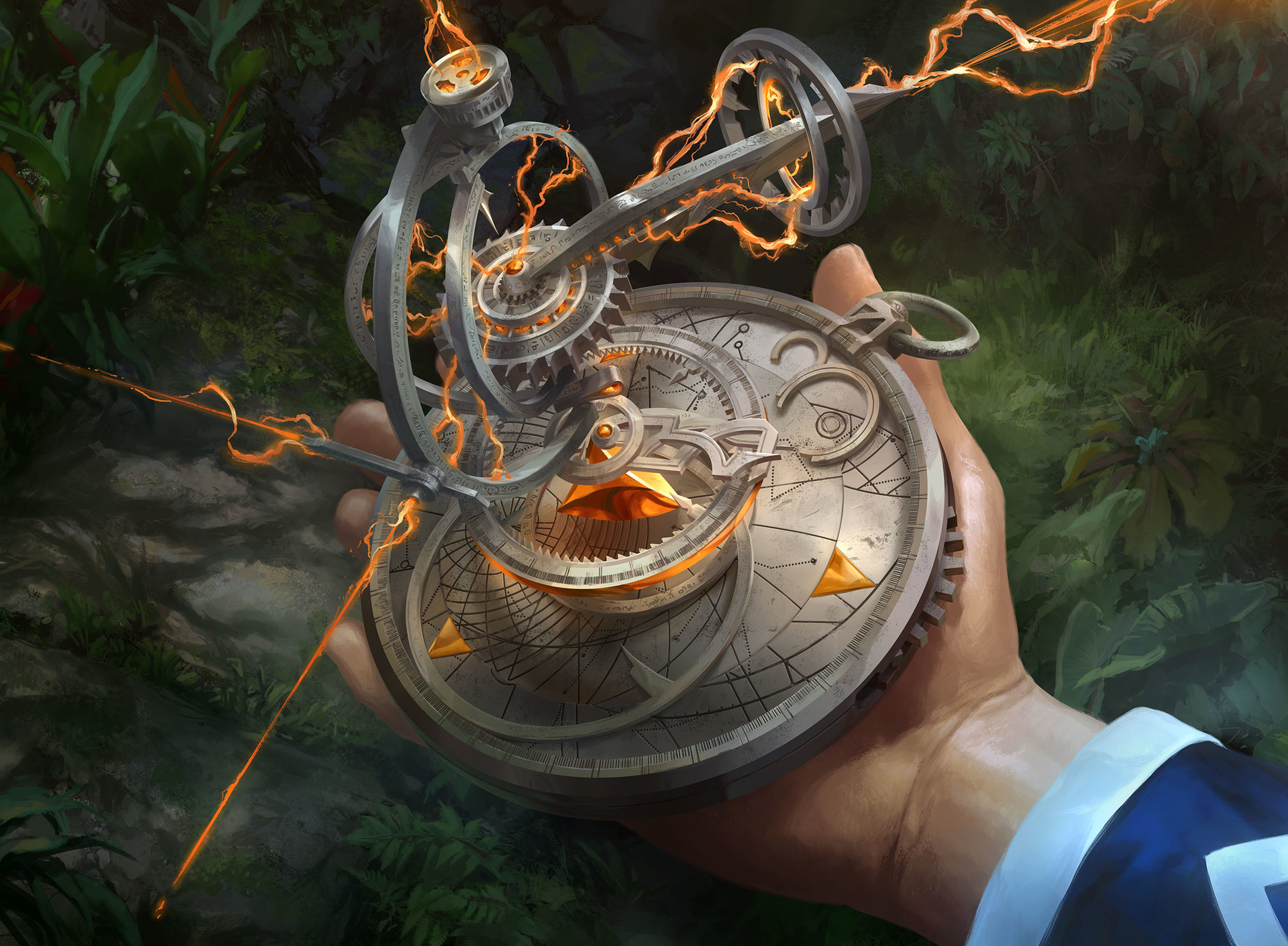
And lo, behold the end result of our long work: fortune writhing on the end of a spear.

Clint Cearley

An Angel of Order is a fairly common angel, usually found on Crest. They have done much to foster the aasimar culture on that moon, contributing their advanced knowledge to its mechanical infrastructure and its highly stratified society.

They come from a universe that was entropy-deficient. It could have held immortal, eternal, not subject to the death that comes for all material planes. But it was destroyed by the hands of mortals, and now they work to ensure this world lasts as long as it can.

Of course, you can also just fight them. Here's an explanation of how I do system-agnostic statblocks, but bear in mind I'm designing these for 5E. Unlike most other angels, they like to fight in teams. They will still all take their first turn off to pray. 

Angel of Order
HD 6 Size Medium AC As chain Speed As human, fly as hawk
Strength 18 Charisma 22
Twinned Swords: Dodge 17, 1d8 + 1d8

Prayer Against Entropy - The Angel of Order will always forgo any other action on its first turn, and will instead pray. After its prayer is completed, all d20 rolls made during combat are instead rolled as 3d6. Critical hits and critical misses are no longer possible. 

Spellcasting - Spell Save DC = 17
3/day: Lightning Helix

Lighting Helix
Standard action, Range 30 ft.
Target creature must make a Dexterity save or take 1d6 lightning damage. If it hits, an ally (or yourself) also within range recovers 1d6 health.

Angel of Scavengers

High above the rotten rows, cloth and metal, teeth and crows!


Lucy Lisett

Most commonly revered by gnolls and kenku, the Angels of Scavengers are perhaps some of the oldest angels. There is no recorded knowledge of their original universe, only rumors of a world without a concept of ownership.

They have been to many universes, and it's said they grow a new eye for each apocalypse they've witnessed. That's unsubstantiated, but what's definitely true is that they collect trinkets from each universe they visit. You're more likely to encounter one as a weird vendor in the middle of a dungeon than as an outright enemy.

Angel of Scavengers
HD 10 Size Large AC As leather Speed As dwarf, fly as crow
Strength 16
Talons: Dodge 14, 1d6 + 1d6 + 1d6 + 1d6

Prayer of Mimicry - The Angel of Scavengers will always forgo any other action on its first turn, and will instead pray. After its prayer is completed, any creature may forgo making a d20 roll to instead use the natural roll of the last d20 rolled.


Angel of Exile

None shall suffer the same fate as our Progenitor. Let there be no more exiles.


Randy Vargas

These draconic angels hail from a universe where Rimhr, the Archdragon, conquered all of space and time. They bore witness firsthand to his cruelty, and protested against him. For this, he cast them out of his domain.

Some say that universe still lives, somewhere out in the web of metaphysics. Regardless, it is certainly dead to these angels.

I would tell you more about them, but my players might read these and I don't want them getting spoiled.

Angel of Exile
HD 8 Size Huge AC As chain Speed As giant, fly as dragon
Strength 22
Greataxe Aflame: Dodge 20, slashing 1d12, fire 1d6

Prayer of Mercy - The Angel of Exile will always forgo any other action on its first turn, and will instead pray. After its prayer is completed, a natural 20 on a d20 roll no longer results in a critical hit. Instead, if your natural roll is equal to or greater than your target's current health, your roll is a critical hit.


---

hey friends,

i don't really know who actually reads this blog, but i hope you're all well during these odd times we're in. if you're inclined to do so, let me know in the comments how you're all doing.

wash your hands, avoid close contact, and use this time to do all the tabletop stuff you never had the chance to before.

Thursday, February 20, 2020

Yetkoli Government

My current game has placed my players in Silverbrine, still known to its 40% elven population as Khayit. It's a coastal city whose human inhabitants have just barely forgotten about the brief, bloody war that introduced its current colonial regime a half-century ago.

Silverbrine is a Yetkoli vassal city - while technically distinct from the Empire, it is ruled predominantly by those hailing from the imperial seat on the other side of the continent.

Specifically, as with all vassal cities, it is ruled by a Septumvirate - a council of seven who write the laws, determine their meaning, and oversee their enforcement. They have complete political and military power within their city, and are kept in line only by infighting.

There are three types of council members: Malghres, Klohres, and Vahres. (MAHL-gress, CHLO-ress, and VAH-ress respectively). Of note is that -hres means "whip" in the Yetkoli dialect of common.

The Emperor's Whip


The Malghres is a single member of the Septumvirate, appointed by the Yetkoli emperor and approved by the Imperial Legislature. Unlike all other positions within the council, it is a life sentence, barring cases where the Emperor or Legislature removes the Malghres from office.

The role of the Malghres is to serve as the will of Empire, which in many cities (none moreso than Silverbrine) is very far away. They are often appointed from the Emperor's personal friends or from military officials that ingratiate themselves to the Emperor - similar to how ambassadors function within the real-world U.S. government. They often wear ceremonial armor or carry ritual weapons into office.

It's very common for the Malghres to abstain from votes within the Septumvirate, coming in only on obviously-unanimous votes or to serve as a tiebreaker. Otherwise, the Malghres's vote is seen as one speaking for the Emperor - and perhaps even the Empire as a whole. Used lightly, that can be a very dangerous thing for everyone involved.

image
Micah Ulrich, Under the sign of Virgo.

The current Malghres is a woman named Daria Bhennok. A short, swarthy woman, she's rumored to have dwarven blood in her ancestry. As far as she is concerned, though, she is pure yetkoli. She has served for 28 years after distinguishing herself during a revolution under the last Emperor. She mainly abides by her role as a neutral party, but has broken her abstinence in the past for policies surrounding spiritual freedoms.

The Purse's Whip


There are three Klohreses, and they are appointed by a board of stockholders who have stake in the specific colony for which the Klohreses serve. Since the creation of the Imperial Legislature in the 1140s following the disastrous Gnoll Wars, the Emperor's budget has been out of their own hands. The Legislature decides it, in addition to having the final say on where the Emperor can declare an expansionary war.

To circumnavigate this, the Emperor began to seek out private investors who were willing to fund Colonial Venture Companies. They provide any extra money the Emperor needs to start the wars that build colonies, getting around the Legislature's financial limits on declarations of war.

In addition to having first dibs on the industry of the colonies they fund, these warmonger-stockholders are able to appoint a vassal city's Klohreses. Typically, these Septumvirate members are most concerned with matters of industry and government budgeting, usually coming from the companies owned by stockholders. Most vassal cities view them as incompetent products of nepotism, and they're mostly right.

Cucculelli Shaheen

Klohreses are also known to hold fancy balls and other social events whenever they're up for re-appointment. Stockholders review their appointments every five years, taking into account their record and popularity within the city. Reappointment season happens in Crucible, after the first twelve days. Within the frame of my current game, reappointment season is coming up in a few months.

The current Klohreses are:
- Setai Merr, the daughter of a yetkoli trade baron. Setai is most well known for being the "party girl" of the Septumvirate, throwing a government-sanctioned ball almost every other month and mostly just voting in accordance with the other Klohres.
- Gardov Vestwryn, brother of a Rikolese CEO that distributes cosmetic alchemical supplies. Notably, he has been re-appointed once already, which is somewhat rare for Klohres. He's known for hard-line conservatism and prioritizing industry interests above all else.
- Lian Jowdaan, a ratfolk. They're a entrepreneur trying to expand the firearm trade into Silverbrine, appointed by a saltpetre mine owner back in the Empire. The first ratfolk to ever serve on Silverbrine's Septumvirate, and one of the few ratfolk to serve in any Septumvirate.

The People's Whip


The last three members of the Septumvirate are the Vahreses. They are the only council members elected by citizens - anyone owning land gets a vote. Their terms last ten years, and they are re-elected in the month of Zuzen. The current Vahreses are in their fifth year in office.

Can't find a source beyond wearemadeofblood.tumblr.com

A Vahres typically is the one who introduces a law to the Septumvirate, as they have constituents to worry about and the most direct ties to the city. A Vahres may only ever serve one term, in order to reflect the changing values of citizens.

Laws regulating who can serve as a Vahres have changed over time - originally, only humans could serve. Right now there's some activism surrounding the removal of the landowner status, but it lacks momentum.

The current Vahreses are:
- Micchi Sabba, a wood elf. Also the first elf to serve in any Septumvirate. The campaign to have him elected was an arduous one, with the Irzmir (Silverbrine's underground revolutionary newspaper) campaigning for him constantly.
- Racha Itte, a yetkoli human campaigning on a platform of "clean politics." His supporters are mainly people who dislike the other two Vahres. He doesn't do much to address the over racism of man of his supporters.
- Chev Kastyron, a lightfoot halfling who's known for having been a poisoner ten years ago. She was inspired to get into politics after having her business shut down by the Silverbrine Reserve, and her backers mostly consist of anti-police voters.

---

sorry 'bout the long delay between posts. since i'm DMing most of my inspiration goes into planning for that. this is still pretty much planning for my current game, but it's something i feel comfortable having public.

i honestly wish this government was weirder, but there's a couple political players in my current game and i wanna keep things fairly familiar to real-world.

as always, go read anders's blog.

Thursday, November 14, 2019

Skills

Here's my attempt to write rules for skills in my spontaneously-self-resurrecting homebrew tabletop system. These aren't complete by a long shot - there's work to be done in regards to how you go about getting them, but this post is just focused on how you play with them.

My goals for these rules are:

  • To use a passive/active system for skill checks that incorporates both Intelligence and Wisdom
  • Avoid modifiers, and use a roll-under system
  • Let the players utilize items to mitigate proficiency deficiency
Madison Safer
Skill checks represent the player characters using their talents and experience to modify their situations. There are two types of skill checks: Knowledge checks and Application checks. These are both d20 rolls.


A successful Knowledge check allows a player character to recall information that is pertinent to the situation. To make a Knowledge check, you check your roll against your Intelligence. If it is equal to or lower than your Intelligence score, you are successful.

You cannot make Knowledge checks untrained, unless you have a source of information on-hand.

Application checks, when successful, allow a player character to significantly change their circumstances. They're more powerful than we consider skill checks in systems like 5E. Application rolls are checked against Wisdom instead of Intelligence. Whenever you succeed on an Application check, cross it off for the day - you cannot use it again until you rest.

You can make Application checks at a penalty if you are untrained in them. This caveat can be ignored if you have the proper tools for the job. 

If you roll under your Wisdom by 5 or more, you do not have to cross your skill off for the day.
If you roll under your Wisdom by 10 or more, you may tack an adverb onto your action (thanks Arnold).

Some classes have access to exclusive skills. Rangers get Terrain as a skill, which they use for tracking things and altering battlefields. Wizards get Spellbook and Relic as skills, which they use for casting. Other classes will have access to these skills (untrained, obviously) on a case-by-case basis.

Wednesday, November 13, 2019

The Twelve Gifts of Crucible

Crucible is the third god of the Thirteen, and also the third month of the year, the last of winter's days. The spheres that Crucible rules over are Wealth and Fate. You might think this would make him cruel, but more than anything he is just absent.

Not a lot of mythology exists revolving around the Thirteen, but Crucible is a rare exception.

In the days after the War of Ichor, the Thirteen were weary from their long battle with the Titans, and wearier still from the treaties brokered afterwards with the remaining mortal races. Crucible saw this, and took action. To cheer his fellows up, most scriptures would say. The more pessimistic would tell you that his actions were meant to boost morale and, thus, efficiency. Whatever the case, Crucible gave the twelve other gods gifts over the next twelve days.

For mortals, this was translated into Loom's holiday season. For the first twelve days of Crucible, people exchange small gifts. Depending on the person, they may also mirror or reference the gifts given in the original myth.

Crucible 1 - Alentyan

For the youngest god, son of an Archlord, Crucible melted down the fat of a maddening beast from the depths of the Shadowfell. From this sprouted a blue candle that could cleave through any darkness. It made for a great reading light, and Alentyan smiled (as best as his beaked face could) at the thoughtfulness.

If one were to give a specific gift this day, it would ideally be as close as possible to the candle described in this myth.

Seb McKinnon

Crucible 2 - Cashel

Cashel inherited the divine spheres of Earth and Water from two separate Titans, and so to this god Crucible altered fate. Before this, gold was the element of the heavens - it was found among the clouds, and hollowed from the highest peaks. Now it is found deep in the earth's belly, and sometimes floating through rivers.

The appropriate gift for this day is a monetary gift, specifically to someone of poor social standing. Most people just flick a gold piece into a beggar's hand, instead of the usual silver.

The people of Zosk revere this event. The dwarves were not nearly as big a fan of this act.

Crucible 3 - Endymeron

After the previous day's gift, Crucible thought it would be wise to give something to the dwarves - Endymeron's people. The three headed god ruled over Air and Time, and as such Endymeron's people philosophized a great deal over those two things. So, Crucible crafted the meteorite.

Stones from the sky are the subject of fierce debate among many dwarven philosophers. Philosophically, they are heretical. Practically, they contain many useful metals.

Specific gifts given this day are usually either trinkets crafted from exotic metals, long-winded essays, or anything given to a dwarf.

Crucible 4 - Graeler

Graeler rules the spheres of Empires and Mind. As such, Crucible thought it would be appropriate to create something that fit both. Something that required mental conquering.

And thus, Crucible wrote the first riddle. Graeler was, uncharacteristically, delighted.

The appropriate gift for this day is, of course, telling your friends a riddle they haven't heard before.

Crucible 5 - Haraad

As the goddess of Nature and Health, Haraad's power wanes with the seasons. Within the calendar she rules over the highest days of spring, closest to the solstice. Conversely, she is weakest in the fall, when life begins to decay and when illness commonly creeps over the populous.

To cheer her up, Crucible tinted the leaves of autumn's last days beautiful reds and oranges. Haraad smiled, a rare occurrence in the dead of winter, when this myth took place.

On this day the faithful typically give a gift to anyone in their life who is, at the time, sick. If that happens to be nobody they know, they give someone a preserved leaf from the previous fall, when the colors yet turned.

Crucible 6 - Jaspus

Fire and Home are Jaspus's spheres, and yet they have trouble co-existing. Light a fire in an enclosed space, and smoke chokes out its residents. This rule has exceptions, of course, but it troubled Jaspus. So, for him, Crucible crafted the chimney.

Jaspus nodded in approval. This was one of the most emotional acts taken by the forge-god, at least in recorded history.

The traditional gift for this day is a red cake, cooked to look like a brick. In some parts of the world, sweeping your friend's chimney is also considered traditional.

Crucible 7 - Ka

What gift do you give to a god of Magic and Chaos?

Ka was tickled by the prospect, especially when Crucible invited them over to a house in Deitia, heavenbound city of the gods. Ka relished the opportunity to topple Crucible's plans.

Then they walked in the door ajar, and a bucket of water fell on Ka's head. Each of their snorts from the resultant laughing fit birthed a slaad.

This is the day of Crucible where you play pranks on your friends.

Crucible 8 - Ouran

On the other hand, Crucible was very confident as to what they needed to give to Ouran. As the god of Morality and, more importantly, Invention, Crucible needed to craft something mechanical. After much thought, Crucible presented Ouran with a compass, late in the day.

A compass is the requisite gift, of course. It would be wise to make sure it's the right kind - giving someone in the eastern hemisphere one that's weighted towards the east pole won't be very helpful.

Yeong-Hao Han

Crucible 9 - Quar 

Crucible's original gift to Quar has been scrubbed from history - apparently, it was horribly offensive. Though, in a roundabout way, Crucible's apology to the god of Truth and Emotion wound up as its own gift.

On the ninth of Crucible, celebrators are supposed to give any long-overdue apologies they might have.

Crucible 10 - Sotiro

For the ruler over Stars and Travel, Crucible crafted the cloudless night - a thing that would allow all lost travelers to find their way home, or perhaps further away from it.

Crucible had to call in several favors for this gift, and as such the most appropriate thing one can do on this day is to offer help to any who may need it.

Crucible 11 - Troyt

Waking up early, Crucible flagged down the second child of the Archdragon. He wanted to show her how to create bronze - for a goddess of War and Lightning, a mainly-copper sword seemed the perfect gift. Troyt would later go on to show her followers that same process.

Bronze trinkets are, of course, the gift of choice.

Crucible 12 - Zuzen

To the dracogod of Law and Thunder, Cashel gifted a book with ever-expanding pages, and a quill with limitless ink. This was to allow him to record as many laws as he could possibly think of. Instead, Zuzen used it to record the names of each god felled during the God Purge, three centuries after when this myth took place.

This day is reserved for gifts to those in mourning.

Sunday, September 1, 2019

Rumor Tables

I'm prepping for an upcoming campaign, and the first session involves collecting rumors. So, I figure I'd better write rules for rumor tables - something I've done before, but wanted to take another crack at.

My last ruleset had players roll 1d6 while I flipped a coin, asking the player to call it but not telling them what it wound up as. What they rolled determined which general rumor they would hear about, while what I flipped determined whether or not the details were true or false. For example:

GENERAL: Rumor has it that the government of a city far to the north known as Nothokari, capital of the Coatbysk, has discovered an ancient magical artifact that was thought lost.
TRUE: The artifact, known as the Witchcrown, was confiscated by the city's current king- though some attempts to steal it have been made already.
FALSE: The current king, known to be a Lightclaimer sympathizer, is currently negotiating a selling price with Subjugator Garrel.

While that system is perfectly functional, I wanted to tweak it. My goals were:
  • remove the secret coin flip - it's better if players aren't necessarily aware that they can find false information.
  • ease the amount of work I, as a DM, have to do. rumor tables shouldn't take more than a few minutes to throw together.
  • incorporate Charisma into the roll, so that some characters are better at collecting rumors than others.

So, that in mind, here's my new system:


Whenever a player wishes to collect rumors, they must pick a specific region or topic to gather rumors on. Then, they roll a d6.

Each rumor table will have at least one true rumor on it. Additionally, the DM will add a number of additional true rumors to it equal to the player character's Charisma modifier. So, at +5 Charisma, the table will be entirely true rumors.

Every other rumor on the table will be, in some way, untrue. It might be a partial lie, or entirely made up. Ideally, even fake rumors point the party in the direction of something interesting. Sure, there might not be buried treasure at the destination they were given - but there is a tiny village home to sprites.

So, as an example, here's a rumor table for Selka. My process for writing these was to do the true rumors first, and then copy and paste the finished rumors to the false section, changing them slightly. Then, I would write an expansion upon the rumor in the spot it left on the true table. This leads to the "false" rumors mostly just being outdated or undetailed, which I like.

However, each table does have at least one true rumor independent from any on the other table. For the True table, this is the omnipresent true rumor that each character has a chance of finding regardless of Charisma. For the False table, it's just something completely made up and not even partially true.

TRUE RUMORS:
  1. Recently, a fungal infection has inflicted heavy damage on this year's war-snail population, damaging trade with other nations. An emissary from Ghr'quoz, a Selkian underwater city, is visiting the surface to investigate, and will pay handsomely for anyone who can help. (stagnant true rumor)
  2. Mining operations for a substance that will burn even underwater in northeastern Selka have halted due to a cave-in, which some say was caused intentionally.
  3. An ancient, immortal warrior from the Obsidian Tide is supposedly being hidden in a large barn somewhere in central Selka, with a visiting Dobarkoli anthropologist attempting to translate the giant's mutterings.
  4. An arctic druid roused the slumbering water spirit within a Selkian glacier, attempting to use it as a weapon of war - which the water spirit wants nothing to do with. It's attempting to run, but that mainly means slowly sliding through eastern Selka.
  5. A mad wizard living in the Brimstone Marsh has been searching for an apprentice as of late, but has been attacked at all the rural villages he's visited - causing him to destroy many of them, mainly in self defense that's gone a little too far.
  6. A number of Selkian exiles have discovered a potent hallucinogen that allows for the development of psionic powers, which they've circulated along with more mundane narcotics - blaming the whole thing on the Rikolese Empire.

FALSE RUMORS:
  1. A visiting Raahilan gunsmith has developed guns for the Selkian military that will function underwater. The factory for them is located along the country's northeastern coast.
  2. A seal rancher recently uncovered what appears to be the crypt of a Giantine warrior while looking for grazing sites.
  3. A glacier that has stayed stagnant for centuries, and is also part of an important religious ritual for pilgrims from Sharsvud, has recently begun to move southward for no apparent reason.
  4. A horrific beast from the Brimstone March has begun to devastate the rural communities of western Selka.
  5. The neighboring Rikolese empire has been smuggling experimental alchemical drugs over the border to attempt to create a dependency among the Selkian surface-borne population.
  6. In southern Selka, there are rumors of a revolution among the Nautilid population, who have long wanted to establish their own nation.
Malachai (Cha +3) and Wrex (Cha -1) both roll to gather rumors about Selka.

Malachai rolls a 5, just over their threshold for a true rumor, and learns about the drug trading going on along the Rikolese border - but doesn't hear about the true party behind it.

Wrex rolls a 1, luckily hearing about the truthful rumor about the fungal infection among Selkian war-snails. 

---

Okay, well after writing this I would actually say it takes longer than my previous system. But it is a lot of fun, and I think a little more streamlined for actual play. It's also a good way to get the gears turning on questlines. I think I'll try this system out in my next campaign, and maybe report back on if it works or not.

Tuesday, August 13, 2019

Hazzem Political Map (Pre-Shattering)

This is a post about Hazzem, the first continent I ever created for Loom and the main setting for my first longform campaign (Overlight, played from like the last day of 2016 'til mid 2018).

Overlight was a post-apocalyptic campaign, though that's somewhat of a misnomer. It wasn't a total apocalypse - there were survivors, and the "Shattering" (the apocalypse-scale event) only affected Hazzem. However, one unique thing about the continent is that (due to an ancient game being played by the fey) it's impossible to leave. Sail off from the west coast, and a mere 60 miles later you'll wash up on the eastern shore. For this reason, much of Hazzem's population believed that Hazzem was the only continent on Loom until after the Shattering.

Anyways, this is a map of Hazzem from before the events of Overlight. Specifically, it would be circa 1330 AEM. Whenever I have time for it, I'll release a map of Hazzem from after Overlight.


Here's a full-size version of this image.

A. The Yetkoli Empire is the mightiest of the human nations that remain on Hazzem after the Quartering, having forced themselves into many formerly-sovereign territories and made them either vassal nations or added them to the Empire as colonies (A2). Their culture prioritizes unification above all else, encouraging its annexed territories to embrace the teachings of Maglubiyet, their namesake and inspiration for their tyranny.

B. Only barely the third-largest of the human Empires, the Linkoli formed post-Quartering from humans who had goblin blood within them. They revere goblinoids as lucky spirits, and nobility within their aristocratic circles is based around who has the highest percentage of "pure" goblinoid blood in their family - often measured through parties designed to test the acuity of one's sense of smell. They're like wine tastings, but revolving around terrible smells (which "true" nobles are supposed to find exquisite).

C. The smallest human nation, and not truly an "empire," the Dobarkoli were refugees from the rampant slaughter of the Quartering. They are not truly expansionist, and have acquired their additional land through negotiation almost entirely. Cartography is seen as the most noble pursuit by the Dobarkoli, and they have a reputation as either the "softy" humans or the "non-imperialist" humans, depending on who you ask. Still, though, they frequent other nations for their map-making and anthropological exploits.

D. The last and second-largest human nation, the Rikolese Empire has a culture of body modification and transmutation magic. Mutations are only as taboo among them as tattoos are in our modern society - still shunned by some circles, but those who do would be considered conservative. They have a colony (D2) in the northeast where they procure cadavers from undead and seafaring races to experiment with new body modifications. Aside from this, they are known for their gothic architecture, rampant vampirism (the cause of much stigma), and spicy food.

E. Dhelkost is a vassal nation of the Yetkoli Empire, a blend of traditional orcish culture modified by human colonialism. It is kept as separate from the Empire so that it can be used as a buffer nation (mainly against Sharsvud), and because many human cities have a stigma against orcs, and would give the federal government hell for allowing them within their borders. Dhelkost has only a few cities and is largely rural. It is also in constant financial crisis - orcs don't understand the concept of a "positive" currency, having used a debt-based economy for thousands of years. Thus, they never spend their money, devaluing Dhelkost's currency into oblivion.

F. Bahkost is a largely agrarian society of orcs, with a society structured around the mastery of disciplines. After maturing to adulthood, an orc will be escorted from their communal raising home and travel to a guild to attempt to become a great artisan. Other races will sometimes, and usually begrudgingly, travel to Bahkost to study. It's also where rich people go to get fancy prosthetics, as orcs are known for being fantastic at creating them. They're known for their springtime theatrical rituals, which are essentially ancient greek Dionysian festivals.

G. Etail Noum, a society of stargazers and astronomers, is an offshoot of Bahkost. They've scavenged much from an ancient Sylvaa society that used to exist in this part of Hazzem. Though they were largely orcish at one point, they have attracted a large immigrant population - particularly halfling followers of Sotiro, the god of stars and travel. Their government is based on astrological signs, electing a leader born under the proper sign for each constellation's season.

H. Sharsvud is the name of a de-facto nation and the forest within which it is located. Another largely orcish nation, it is effectively an anarchy - the closest thing to a government is the council of High Druids, who would snort and spit black phlegm at you for calling them a government. They collectively worship a divine boar called Thousand-Pierced Yev'rott, who they believe will trample human society underfoot. There is internal squabbling about whether or not to allow worshippers of Yev'rott from other nations to live among them. Despite all this, life there is fairly peaceful, if rough-and-tumble.

I. Intihk-bel is the first of the gnoll nations, located in the highlands of the Wedgeplains. They have a noble culture, and trace their ancestry to an ancient demon-hunting society that died due to an infertility curse placed upon them. Descendants of that empire revived it centuries later, borrowing as much as was recoverable from the old ways. They are isolationist and have managed to repel imperialist human forces, but squabble with seasonal pilgrims from Sharsvud. Their aristocracy has regained the ability to reproduce naturally, and uses this as a status symbol.

J. Knoss-if'r is the other gnoll culture, who keep to the areas of the Wedgeplains beneath the escarpment that separates them from Intihk-bel. They rejected that original demon-hunting society, starting a group of nomadic societies that worship and fear nature. Unlike their northern cousins, they have been steamrolled over by the Yetkoli empire, who erected railroads through the Wedgeplains and use it for cattle drives from the west. Despite this, Knossian culture continues to survive and adapt to the strange new world they find themselves in.

K. The Havaak Bhounad is a dwarven nation dedicated to a singular purpose: protecting the Jahtulan Mountain Range from outsiders. After frequent encroaching from (mostly human) outside nations, it was established in the late 1200s to prevent the coups that plagued dwarven Hazzemite society throughout that century. Fierce and uncompromising, they also serve as an outlet for growing militaristic tendencies within dwarven youth.

L. The Kingdom of Vonnia is a halfling nation that exists as a buffer between imperialistic human societies and the rest of Hazzem, attempting to ease tensions. They are a toxicracy - their officials are chosen based on who can survive intentionally ingesting deadlier and deadlier poisons. Tenacity is the name of the game in their culture - if they should falter and fall to invasion, that could pave the way for total war in Hazzem. "Vonnia" is an incredibly poisonous flower native to the Kingdom, though that isn't known to most outsiders.

M. Located in a swamp rich in Nightsap Trees, the Dripwoods Republic is another halfling nation, famous for its production of high-quality ink. There's also a tinkering culture, and many outsiders immigrate to the swamp for tutelage under some of the brightest - or maybe just the boldest - mechanics on Hazzem. The government is also desperate to be annexed by the Kingdom of Vonnia for increased protection, but their neighbor lacks the resources to be able to properly establish themselves in the swamp.

N. Saltoff is a city-state named for its capital, a vibrant port town. It is populated mostly by bugbears, who have a maritime culture and revere the sea - a holdover from their days with the seafaring giant empire known as the Obsidian Tide. Salt is not only the namesake for the nation, but also its currency and a big influencer on its culture. Salt barons hiring assassins to kill their rivals. Divorces taking place over whether or not sea salt or pink mountain salt is better. The human empires, particularly the Rikolese, are their main customers. They also have huge domesticated war-crabs, which they use in their frequent squabbles with Zosk - who they've hated for as long as anyone can remember.

O. A primarily-hobgoblin nation, named for their founder and first philosopher-queen. She taught that precious metals (which also happen to be Zosk's primary export) are manifestations of divine purity. Coincidentally, Zosk's main river (the Okarr) is very rich in gold. Panning for it is a humble-but-respected profession, and it drives the economy. Zosk is famous for its paladin order, the Knights of the Current, who repel evil spirits from Hazzem's waterways. They are also the primary defense against Saltoff, who they've hated for as long as anyone can remember.

P. Once a colony of the dragonborn to the west, Arx Remelai ("Rising Claw" in draconic) is located in a massive canyon, supposedly made by Rimhr's talon during the Fall of the Archlords. They're a theocracy, focused on the worship of the draconic gods and populated almost entirely by kobolds. They're one of the few people who are consistently on good terms with Hazzem's dwarves, and often send out missionaries to provide humanitarian aid. Their leadership is based on a reincarnating council, the Claw's Fingers (Fetani Arx) - one for Zuzen, one for Troyt, and two for Rimhr.

Q. A vassal nation of the combined human empires, Numenion is a lawless land of extreme natural beauty. It was pretty much free for the taking when the humans showed up. Everyone else had learned to stay away from it, because it's home to a menagerie of horrifying and incredibly dangerous monsters. Only through their combined military might were the empires able to establish a nation there, and even then there have been difficulties creating many permanent settlements. A few disparate other races have also begun to populate it, seeing as they never had the opportunity to before.

R. A fierce isolationist culture of the mysterious Ghostwise halflings combined with a smaller population of firbolgs and elves, the Velikutae Forest Federation sends a message in poison-tipped arrows to any who set foot inside their woods: stay far away. Little is known of them, and ambassadors are sent out to other nations very infrequently. The Yetkoli have had their eyes on Velikutae forest for as long as they've known about it, especially since they learned that within it is an entrance to Hazzem's underdark - where anti-authoritarian elves plot coups against the empires. However, they have not yet found the resources to pursue the endeavor of invading the Federation.

S. Portwheld is a well-established culture of dragonborn who immigrated from the continent Starfyk to the west. One of the most frequent opponents for the human empires in recent days, they especially despise the empires on the basis of their insistence that Hazzem is the only continent - as they are literal descendants of people from another continent. Though their origin nation worshiped draconic gods almost exclusively, Portwheld now generally worships the Thirteen, though religion is generally lax there. They're also known for eating food that is truly, horribly disgusting to almost everyone else, because of how different dragonborn digestive systems are to mammalian ones. They have a small colony (S2) on the island of Xotam to the west, left over from when they first immigrated.

T. A small nation granted autonomy by Portwheld, Doomfall exists for the explicit purpose of welcoming new arrivals to Hazzem. Due to being sealed off from the rest of the world, Starfyk to the west will often ship their greatest prisoners eastward to their doom on the cursed continent - hence the name. They also host Hazzem's church of the Undead Guardians, a pantheon worshipped almost exclusively by adventurers. They welcome refugees, mainly meaning elves that got forced out of their desert home to the southeast by Yetkoli occupation.

U. Appearing out of nowhere very suddenly and quickly laying claim to much previously-occupied human colonies, the Aerapi Territories are ruled over from a floating island nation of gnomes - small, insectoid people related to the fey. As such, they can travel through the barrier around Hazzem unfettered, and frequently offer asylum on outside continents for those who would seek it. This infuriates the human empires, who disliked having their colonies pulled out from under their feet and dislike having their worldview questioned even more.

V. The coast of a haven for all of Hazzem's underwater races, "Selka" is the name for their land-borne penal colony. Merfolk, cecaelia, and the odd nautilid take up humble lives here as seal ranchers. Many aspiring anthropologists travel here, mainly from the Dobarkol Kingdom, to take the unique opportunity to research these elusive races. Missionaries travel for similar purposes. Both groups have little success, but they did start an interest in collecting Selkian war-snails and jewelry among the human empires.

W. Vukkral is the oldest name known for the northwestern island, and it was its name given to it by the trolls who first settled it. Refugees from the God-Titan War, the fledgling society was mercilessly crushed by the Obsidian Tide (one of the Giantine Empires) a few centuries into its lifespan. It never properly recovered, being a shadow of its former self. Despite this, its inhabitants are universally cheerful folk, who delight in meeting others. Except when they're hungry. Then they'll just eat you.

X. Ta'Galot is a recent society, comprised mainly of elves exiled from their desert homeland after being occupied by the Yetkoli Empire. However, because elves evolved in a desert, most of them are unable to survive for long in the frigid environment of Vukkral. The exceptions to the rule are the frost elves, who have a much slower metabolism. Therefore, Ta'Galot represents the largest frost elf population on Hazzem, and many have traveled to it despite not being exiled. There is no official government there, as most of the establishments are universities and research stations. However, they are provided protection by their neighboring trolls and an organized crime ring, the Navah'hken Division.

Y. An isolationist and largely undisturbed culture, Imi Xotam tends to their home island, unconcerned with the squabbling on the mainland. It is mainly populated by humans (separate from the original group that founded the Empires), but also have a small population of dwarves, elves, and dragonborn. They are primarily concerned with honoring and caring for their slumbering god, who was critically wounded during the God Purge and is said to be waiting to reawaken during Imi Xotam's hour of greatest need. They also serve as one of the best sources of knowledge on giantine culture, speaking a version of common that's closer to its root language of Giant and preserving many stories of the old Empires.

Z. The Churntide Isles are an archipelago inhabited by native ratfolk. They grant rulership on the basis of whoever is the best at repelling the sea monsters that frequent their home, naming them Reaver King - an honor held for the past decade by a pirate named Ghunyan. The Isles produce many brilliant inventions, but are known especially for making the best firearms on Hazzem, and potentially on Loom. They're also a fairly young race, worshiping the prophet who gave their society civilization and using a different calendar from most of Hazzem, which starts with their race's awakening. They frequently trade with the Havaak Bhounad, Saltoff, Zosk, and occasionally the human empires.

The grey areas are neutral territory - unclaimed by a government, or unexplored.

---

Shoutout, as always, to my fellow Loom DMs for the inspiration for much of this as well as help with occasional lore pertaining to their races. Specifically, Anders was the one who came up with the Navah'hken Division for their character's backstory. They also played in my campaign that inspired a lot of this lore, so thanks to them (as well as Griff, Magnus, Nick, and Vanya) for that!

Also thanks to Ace for helping me with some Hebrew!

Monday, July 29, 2019

A Slice of the Pie for D&D

Heya everyone.

This post is gonna be different from my usuals. I'm not focusing on anything in-universe here, this is more of a game rules thing. It's also not using content original to me - rather, I am intended to port one system over from a completely different game to replace one in this.

This is less of a creative endeavor, more of a manifesto. This is my explanation as to why, for almost a year now, I have been thinking of D&D characters not in terms of alignment...

...but in Magic the Gathering's Color Pie.

Image result for magic the gathering color pie

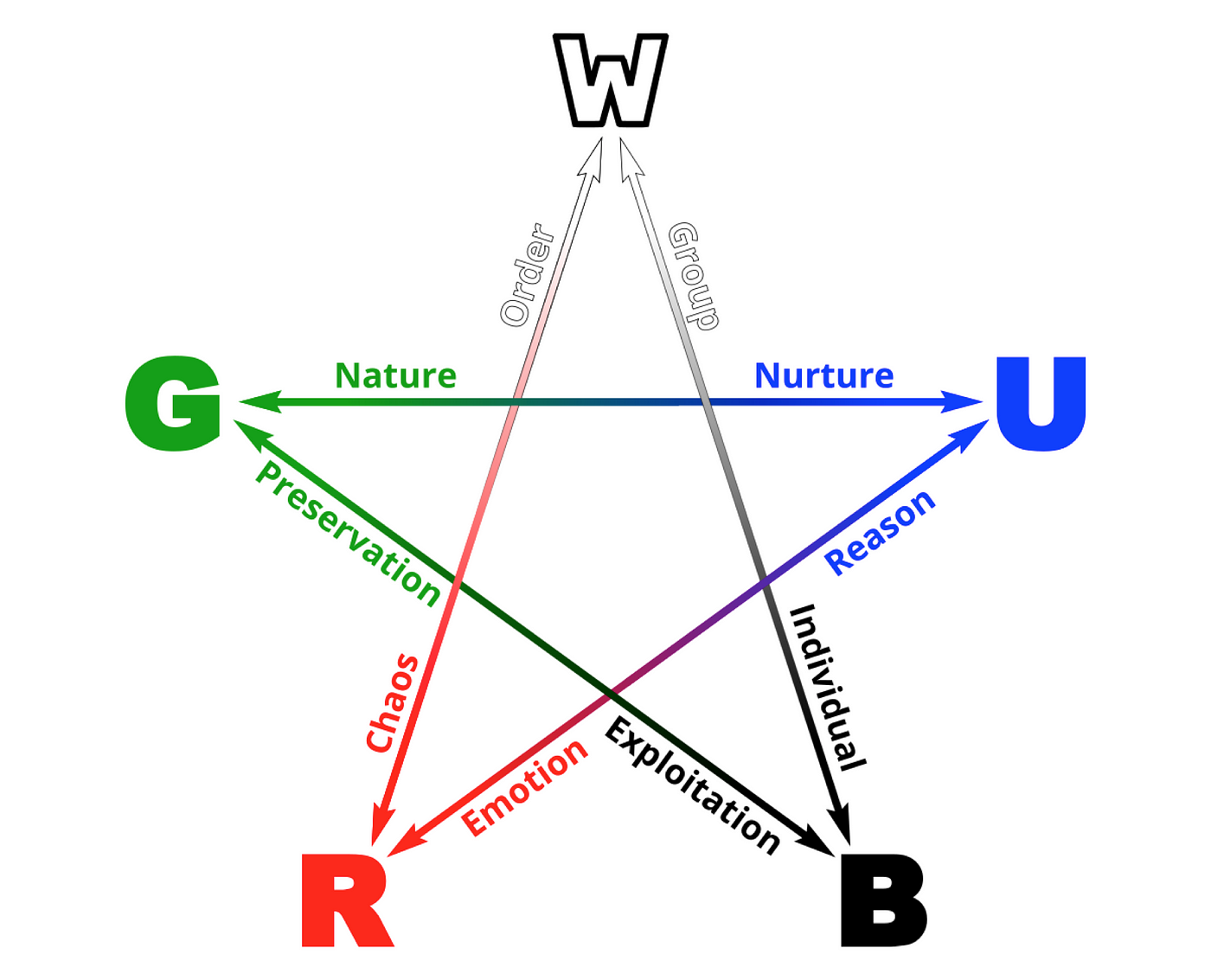
This is that color pie. In clockwise order, the colors are White, Blue, Black, Red, and Green. (sidenote: blue is abbreviated as "U" due to its first two letters being the same as Black's). In Magic's lore, these are the colors of mana, a spiritual force that powers magic. In Magic's design, the mana colors serve as a way to limit the abilities of decks.

Red is naturally a very fast color, so it works well in aggressive decks. However, it's bad at playing the long game. Blue is the most reactive color, able to deal with anything once it gets its resources set up - but if something can get its foot in the door, Blue is unable to deal with it cleanly.

However, they also serve a philosophical purpose. Each of these colors gives us a different outlook on life.

White is the color of humility. It accepts that the world is scary and dangerous, and that pain and suffering are inevitable. It seeks to minimize these things. It is not afraid to kill - and it often will, if it means protecting people and society. But where possible, it will instead restrain, and rehabilitate. It also seeks to bolster its own defenses against the world by maintaining powerful, unshakable connections. White is the chain that keeps your bike locked up so that people can't steal it. White is also the chain that bonds you - for the greater good.

Blue is the color of memory. It is concerned with watching and waiting, and then learning from what it sees - to better anticipate the future. Given the proper resources to flourish, Blue can wield the heavy power that knowledge provides to a studious mind. It simply needs its time to pour over the past, so that it can confront the future. It is unconcerned with good and evil, and cares more about learning from what figures described in those terms did. Sure, Blue concedes, maybe this military dictator committed many atrocities. But have you seen his battlefield formations?

Black is the color of ambition. It is willing to sacrifice others in pursuit of its goals, or sacrifice its own short-term benefit towards its long-term desires. It plots and schemes and makes compromises to achieve what it believes to be "good" - not good as in it helps the most people, or as in something commonly accepted as morally righteous. Rather, what is good to Black is simply understood as fact, the culmination of one's experiences that inform one as to what is the correct course for the world - whether that world knows it or not.

Red is the color of passion. It measures lives not in length, but in experience. Going down swinging is far preferable to dying in your sleep to Red. Not swinging for a cause, but simply living - and dying - in the moment. It keeps moving forwards because it sees only the one time it emerges in a shower of exhilarating glory, not the 99 times it dies on the end of a spear, sputtering blood. It jumps immediately into action and throws everything it has at a problem, not worrying about the likely possibility of simply running out of steam and bleeding out. If you live for the future, Red would argue, you're scarcely living at all.

Green is the color of existence. It lives, period. It is much more concerned with the "how" of that statement than the "why." For it knows that understanding lives not in the brain - in things like comprehension and retention - but in the feet, feeling the earth under your toes that connects you to each other living thing. Not that it relies on them - Green is ferocious on its own - but it accepts that all living things have their place in the world. Sure, its own might be in the maws of a bear - but maybe it IS that bear. Truth be told, it's content either way.

(This pretty excellent article explains all of this in more detail, and is also where I lifted the above picture from. If you read it, be aware that it goes much more in-depth than I am, and also that it has some political undertones, if that would make you uncomfortable.)

Also important to these colors is the intersection of them. Refer back to the above chart - the colors are placed where they are for specific reasons. The colors they neighbor are their allies, and the colors they're across from are their enemies. Green gets along well with White and Red, but disagrees fundamentally with Blue and Black. That isn't to say that Blue and Green could never get along, but enemy colors being paired together is usually more volatile.

Image result for magic the gathering color pie
White is often depicted in gold, and Black in purple. Image from Wizards of the Coast.

So, with these colors, it would be pretty easy to map out the alignment chart in their terms.

White is Good, Black is Evil.
Blue is Lawful, and Red is Chaotic.
Green is neutral, on both axes.

Your lawful neutral character is blue-green. The chaotic good ranger is red-white, and the lawful evil villain blue-black.

However, that isn't really satisfying.

In Magic the Gathering, there exists a setting called Ravnica. This ecumenopolis is based entirely around the color pairs, and they manifest in the form of ten guilds that run certain parts of the city's responsibilities.

The Simic Conclave (Blue/Green) is, officially, in charge of medicine and the plane's waterways. However, they also have a penchant for genetically splicing various animals together to create monstrosities that often escape captivity and wreak havoc on the rest of the plane.

The Boros Legion (White/Red) is Ravnica's military force, which recruits and trains from almost anywhere. Its members are fiercely loyal and dedicated to the idea of the Legion, unable to see any of its flaws - the rest of the plane is simply in the wrong, as they see it.

And finally, the House Dimir (Blue/Black) are shadowy agents who deal in secrets. Officially, they circulate information, serving as the humble newspeople of the plane. But unofficially - and the unofficial is the crux of what being Dimir is - they have eyes everywhere. They run surveillance on every other guild, and plot in the shadows to bring about... well, nobody really knows what their goals are. But it is agreed that they intend to keep it that way.

And that... doesn't really map to my proposed alignments, does it? The monster-unleashing Simic are hardly lawful in any capacity. Meanwhile, the supposedly-chaotic Boros DO value law and order above most other things. And the Dimir are too enigmatic to even describe.

But that doesn't mean that a blue/green character couldn't ever be "lawful neutral," nor a red/white character "chaotic good." It just means that D&D's alignment system isn't a great descriptor for complex characters.

This is why I have let MtG's color pie usurp the position that alignment was supposed to fill. I find that my characters, both when I am a player and a DM, benefit greatly from this. Two Neutral Good characters are "supposed to" act the same in a given situation, but two White/Green characters may behave totally differently based on a number of different factors - such as the people they are with, or which color they lean more towards in that given moment.

It also allows you to inject different factors into your character's color identity. An elf in traditional D&D settings might be drawn more towards White, Blue and Green. A bard is naturally going to connect more with Red, the color-patron of the arts.

The point is to break away from alignment as a system. I've disliked it for a long time, and I've written before about attempts to rationalize character decisions in-universe through different means. And while simply translating a character's alignment into colors is a good place to start for people with attachment to that system, ultimately I would like to see alignment as a concept go away.

It's just good character writing. I don't act the way I do in real life because I'm some abstract concept of good or evil, lawful or chaotic. However, I find it fairly easy to describe myself as Green-Black.

A few miscellaneous things:

  • I find that most player characters are two-color or more. When doing this thought experiment, don't limit yourself to trying to pin a character down in just one color. A character might take a few features from two or three colors, or synthesize something unique to a color pair that the individual colors simply don't yield. Here is a list of the "canonical" names for the two, three, and four-color groups, for those interested.
  • That being said, there's nothing wrong with mono-colored characters. Each of the five colors is a deep well of concepts and tropes that can be drawn from, and a character being mono-colored just means they dive deeper into that well, whereas a multicolored character pulls specific things from each well. Notice that almost all alignments are color pairs, and they're more than capable of being basic and uninteresting. 
  • Characters of the same color identity can be radically different. Pulling from MtG again, the Merfolk of Ixalan are a race of indigenous people dedicated to protecting a secret city. They were tasked with this endeavor by a godlike being millennium ago, and the task is strongly rooted in tradition. Their associated colors are Blue and Green. Notice that they are nothing like the Simic Conclave mentioned earlier. That is an advantage of the system, not a downside of it.
---

Hello! Thank you for reading this long-winded post. It's something I've been meaning to discuss for awhile, and I hope if nothing else it gives you something to think about.

The second edition of Colorful Replies was what finally got me to get off my ass and write this thing. It's written by Mark Rosewater, the head designer of Magic. It's a great way to familiarize yourself with the colors on a more personal level. The first edition of it is here. I really cannot recommend these posts enough - they are funny and super insightful.

Another inspiration to start writing again was my friend Anders, who started their own D&D blog, Robot of Dawn. They are a fellow Loom DM, and the influence their writing and roleplay has had on my own is staggering. Their stuff is great, and I cannot recommend it enough.

Finally, I'm tagging this post as MtG because I might blog about it more in the future. It's grown as an interest of mine, almost rivaling D&D's ability to captivate me. And hey, they're both made by the same company, but made great by the communities who fuel them. We'll see if that shakes out.

Again, thank you for reading. Have a nice day!